
The meal begins before nutrients enter the bloodstream
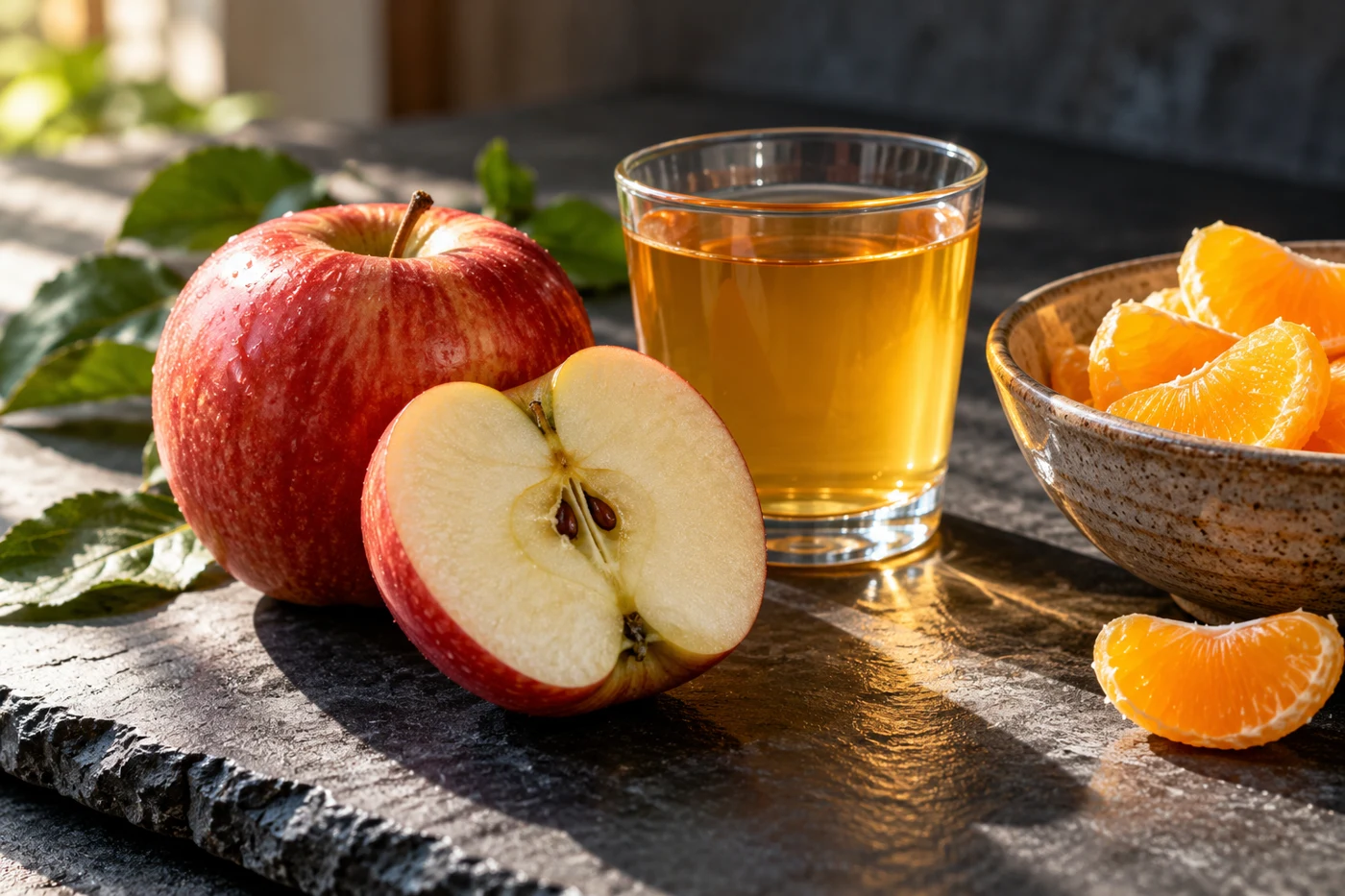
An apple and a glass of apple juice can share a familiar flavour while asking very different things of the person consuming them. One must be held, bitten, chewed and swallowed in stages. The other may disappear in a few seconds. That difference is easy to overlook when a food is reduced to a number on a label. Yet the experience of eating is part of the question, not an inconvenience surrounding the chemistry.
The useful concept is the food matrix: the physical organisation of a food, including its cells, water, fibre and other components. Thinking about structure does not mean calories cease to matter or that whole foods possess a hidden healing frequency. It means that nutrient information and the process of eating describe different aspects of the same meal. Both deserve attention when we ask why two meals leave someone differently satisfied.
I prefer to begin with a modest question: what does this food require, and what happens afterwards? This directs attention towards observation rather than moral judgement. A person who finds a liquid breakfast less satisfying has not failed a test of discipline. Equally, someone who needs a soft or liquid meal has not chosen an inferior way of nourishing the body. The purpose of understanding structure is to improve fit, not create another hierarchy of purity.
Evidence: whole apples, purée and juice are not identical experiences
A controlled crossover study involving 58 adults compared apple segments, applesauce and apple juice before a meal. The preparations were matched for several features, including energy and ingestion time. Whole apple produced greater fullness and lower total lunch intake than the other apple forms. Adding naturally occurring amounts of fibre to juice did not recreate the whole apple result. This was an acute meal experiment, not evidence that eating an apple guarantees weight loss or prevents disease. [1]
A separate small crossover study used MRI to investigate what happened after participants consumed whole apples, apple purée or juice. Whole apples emptied from the stomach more slowly than the processed forms and produced greater reported fullness and satiety than juice. The investigators studied 18 healthy adults, so the result provides a useful physiological clue rather than a universal rule for every age, digestive condition or complete meal. [2]
These studies challenge an overly simple replacement argument: if two foods contain similar energy or added fibre, their effects must be interchangeable. The evidence supports a narrower conclusion. Form can influence the eating experience and subsequent appetite under controlled circumstances. It does not tell us to fear juice, discard useful purées, or assume that every alteration of a food produces the same response. The question remains specific to the preparation and the outcome being measured.
Evidence: chewing and eating rate contribute, but are not magic controls
In a crossover experiment with 50 participants, a harder lunch was eaten with smaller bites and more chewing per gram than a softer lunch. Energy intake at lunch was lower after the harder foods, without a compensatory difference at the subsequent dinner. This links texture with oral processing, but the observation covers a short period in a particular study population. It cannot establish what happens over months in ordinary households. [3]
Another randomized crossover study asked 45 adults to chew food different numbers of times relative to their own usual chewing pattern. More chewing reduced meal intake, while reported appetite at the end of the meal did not differ. The distinction matters: a change in the amount eaten and a change in perceived fullness are related possibilities, not the same measurement. Counting chews is therefore not a clinically established universal appetite prescription. [4]
The practical lesson is not to turn every mouthful into an exercise. An instruction can become so demanding that the meal becomes another performance. Instead, these experiments invite us to notice whether eating arrangements make food almost effortless to consume before attention catches up. Texture, portion presentation and a workable pace can be considered together. None removes the need for adequate nourishment, enjoyable food or attention to circumstances outside the plate.
Practical implications: build a satisfying meal rather than a chewing ritual
For someone who can chew and swallow comfortably, one ordinary comparison is to include some fruit in a form that requires eating rather than drinking. Fresh, frozen, canned and cooked fruit can all have a place. USDA advice emphasises including fruit in everyday meals and snacks, with practical options such as fruit on cereal, portable fruit or fruit added to a savoury meal. The aim is availability and variety, not expensive perfection. [5]
Choose a change that remains easy on a busy day. This might mean carrying a piece of fruit to work instead of relying on a drink because nothing else is available. It might mean keeping prepared fruit visible in the refrigerator. If fresh produce is inconvenient or frequently wasted, a workable stored option may support more consistent eating than an ideal purchase that is never used. Convenience can support nutrition as well as undermine it.
Look beyond the individual ingredient to the whole eating occasion. Ask whether the meal contains enough food, whether it is eaten in a rush and whether there is time to notice comfort before adding more. A person can slow a meal simply by sitting down when circumstances allow, putting the phone aside or sharing it with someone. These are optional arrangements, not requirements for successful digestion. Their value is whether they make eating more manageable.
Practical implications: observe satisfaction without turning it into surveillance
A useful observation has a clear purpose and a stopping point. Compare two realistic breakfasts on similar days and notice whether either makes the morning easier. Avoid changing the portion, sleep schedule, caffeine intake and exercise routine simultaneously if the intention is to understand the contribution of food form. Even then, the comparison remains personal experience rather than a controlled experiment, and it need not produce a numerical score.
Consider several outcomes rather than hunger alone. Was the meal enjoyable? Could it be prepared within the available time and budget? Did it provide enough energy for the morning? Did discomfort interfere with normal activity? A meal that maximises fullness but leaves someone unable to meet nutritional needs is not automatically an improvement. Satisfaction belongs within a broader account of functioning, especially when appetite is already limited by illness or treatment.
Stop the observation if it becomes a source of anxiety or a way to justify restriction. There is no need to repeatedly test whether hunger has arrived on schedule. Appetite does not become trustworthy only when it follows a rigid plan. The intended result is a small amount of practical knowledge: which meals support the day, which need adjusting and which questions merit a conversation with a dietitian. More monitoring is not always more understanding.
When softer food is the appropriate choice
Swallowing difficulty changes the priority. Coughing or choking while eating, food sticking, a wet or gurgly voice after drinking and unexplained weight loss can indicate dysphagia. NHS guidance recommends assessment and, when needed, advice from a speech and language therapist or dietitian. Changes to food texture or drink consistency may be part of care. A general suggestion to choose harder foods must never override that individualized swallowing plan. [6]
This is where apparently simple wellness advice can become misleading. A study showing reduced intake with harder food does not imply that reduced intake is desirable for every person. Someone recovering from illness, struggling with chewing or unable to finish meals may need food made easier to eat. The clinical aim may be sufficient energy and safe swallowing rather than prolonged oral processing. The same food characteristic can be useful in one situation and unhelpful in another.
Do not try to diagnose a swallowing problem by testing increasingly challenging foods at home. Seek assessment, particularly when symptoms are new or worsening. Nor should every smoothie be dismissed as nutritionally empty. Its ingredients, purpose and place in the overall diet matter. A person who uses a soft meal appropriately should be supported to meet their needs, not encouraged to trade a safe and workable solution for a fashionable principle.
Limits and unanswered questions: an acute response is not a life outcome
Laboratory studies can isolate aspects of food form that are difficult to separate in normal life. Their strength is that a specific comparison becomes visible. Their limitation is that the meal is observed under arranged conditions. Small samples, short follow-up and selected participants leave uncertainty about lasting effects, adaptation, cultural food patterns and the influence of mixed meals. The apple studies are useful evidence about apples in those settings, not a complete theory of appetite.
It also matters which outcome we want to improve. Eating less at a test lunch does not demonstrate better nutrient adequacy, a healthier relationship with food or a lower risk of chronic disease. None of these outcomes should be silently substituted for another. If an article moves from a short-term satiety experiment to a promise of longevity, the missing steps in that argument deserve to be made visible rather than covered by confident language.
There are further questions worth studying: how age and dental health alter these responses, whether a texture change remains useful when meals are freely chosen, and how to retain enjoyment when therapeutic diets require modification. We can respect these uncertainties without abandoning the practical idea. Food is encountered as something to eat, not merely as a calculation. Recognising that fact allows more thoughtful choices while leaving room for individual needs and better evidence.
A perspective on nourishment that leaves room for context
Within my broader writing about eating, the meaningful distinction is between paying attention to the body and trying to dominate it. Food structure offers a concrete subject for that attention. It asks us to examine ordinary details without imagining that every sensation carries an instruction to restrict. This is an interpretive perspective, not a validated treatment system, and it should remain separate from the experiments discussed above.
A good meal need not satisfy a theory before it can nourish a person. It may be soft, quick, shared, improvised or carefully prepared. The question is whether it supports needs within the conditions of that life. If a whole-fruit option makes a routine more satisfying, keep it. If chewing or swallowing makes it unsuitable, choose appropriate alternatives and obtain help. Understanding is valuable when it expands workable choices rather than removing them.
Related reading
- Ultra-Processed Foods: Read the Pattern, Not Just the Label
- Protein Across the Day: A Practical Question for Healthy Ageing
- Meal Timing and Circadian Metabolism: The Clock Is Part of the Context
- Resistant Starch: Why the Same Food Can Produce Different Gut Responses
Author and medical note
Written by Gabriel Nicolaev – CyGuru. This is general educational writing and author analysis, not a personal diagnosis or treatment plan. Discuss symptoms, treatment changes and supplement interactions with a qualified clinician. No independent medical review is claimed.
References
- Flood-Obbagy and Rolls. The effect of fruit in different forms on energy intake and satiety at a meal. Appetite, 2009.
- Krishnasamy et al. Processing Apples to Puree or Juice Speeds Gastric Emptying and Reduces Postprandial Intestinal Volumes and Satiety in Healthy Adults. Journal of Nutrition, 2020.
- Bolhuis et al. Slow food: sustained impact of harder foods on the reduction in energy intake over the course of the day. PLoS One, 2014.
- Zhu and Hollis. Increasing the number of chews before swallowing reduces meal size in normal-weight, overweight, and obese adults. Journal of the Academy of Nutrition and Dietetics, 2014.
- USDA MyPlate. Focus on Whole Fruits.
- NHS. Dysphagia (swallowing problems).