Food debates become unhelpful when a classification begins to function as a moral verdict. A person holding a packaged loaf should not need to decide whether buying it makes them disciplined or careless. The useful question is what that food contributes to the eating pattern, what it tends to replace, and how easily the overall pattern supports nourishment without persistent excess.
Ultra-processed food research deserves serious attention. It also deserves precise interpretation. A finding about a whole experimental diet does not establish an identical effect for every item within a broad category. I think the strongest position combines two abilities: recognising the influence of the food environment and refusing to surrender judgement to a single label.
Processing is a broad description of transformation
Cooking, freezing, milling, fermentation and packaging all change food in different ways. Those changes can improve convenience, storage, safety or accessibility. The NOVA category of ultra-processed foods refers more specifically to industrial formulations and their characteristics; it should not be used as a synonym for everything that comes in a packet.
The NHS makes an important practical distinction: some products classified as ultra-processed can fit within a balanced diet, including certain wholemeal breads and higher-fibre cereals. Many other products in the category are rich in salt, saturated fat or free sugars and are easy to consume in large amounts. The category therefore contains variation that matters at the shopping basket level.
Reading the label and considering the meal are complementary actions. An ingredient list may raise questions about formulation, while the nutrition panel helps compare fibre, protein, sugars and salt. Neither replaces the question of what is actually eaten over days and weeks. A favourable word on the front of a packet cannot settle that larger question.
What the controlled feeding evidence adds
In the 2019 inpatient crossover trial led by Kevin Hall, twenty adults were offered ultra-processed and unprocessed diets in a controlled environment. They ate more energy and gained weight during the ultra-processed condition, while the opposite pattern occurred during the unprocessed condition. Because the investigators assigned the diets, the experiment provides stronger causal evidence than a simple association between reported habits and later health outcomes.
Its scope still matters. The intervention lasted weeks, involved a small group, and compared complete menus. Several characteristics of meals can travel together, including texture, eating speed, energy density and palatability. The experiment does not isolate every mechanism or establish that a particular additive caused the observed effect. It demonstrates that the assigned dietary environments produced different patterns of intake.
That distinction is useful outside the laboratory. A meal can make eating a large amount easier without the person experiencing that as a conscious decision. Recognising this does not remove personal agency; it gives agency a more realistic task. Changing the available options may be more effective than repeatedly demanding stronger resistance to the same environment.
A newer trial asks about diets that meet healthy-eating guidance
A 2025 randomised crossover study in Nature Medicine compared minimally processed and ultra-processed diets designed to follow healthy-eating recommendations. Both conditions produced weight loss, but the minimally processed condition produced a larger reduction. This extends the question beyond a contrast between an obviously poor menu and an obviously nutritious one.
It is still not a universal ranking of individual foods. The study was limited in duration and participant characteristics, and the menus represented particular implementations of each diet. Its contribution is to suggest that processing-related features may matter even when attention is paid to conventional nutritional guidance. It does not make nutrient quality irrelevant or establish that every household can reproduce the trial's conditions.
When reading this work, ask what outcome was measured, how long the exposure lasted and what was supplied to participants. A change in body weight is not a direct measurement of every proposed pathway involving the microbiome, inflammation or cancer. Mechanistic explanations need their own evidence rather than being imported because they sound compatible with the result.
Observational evidence answers a different question
Long-term studies often compare people who report different levels of ultra-processed food intake. Such studies can reveal patterns worth investigating, but they also capture differences in income, smoking, physical activity, access to care and many other exposures. Statistical adjustment helps; it cannot guarantee that every relevant difference has been removed.
Dietary questionnaires introduce another layer of uncertainty. A person may not know the formulation of a food eaten years earlier, and a classification can be difficult to reconstruct from a broad questionnaire item. This does not mean that all observational findings should be dismissed. It means that confidence should depend on consistency, study design and the wider evidence, not the dramatic quality of a headline.
An association with a disease does not tell an individual that one packaged food caused their illness. It certainly does not justify blame. Health emerges from many interacting factors. A useful article should support better choices while keeping the reader's understanding proportional to what the data can actually show.
Use a replacement question instead of a purity test
The World Health Organization describes healthy diets through adequacy, balance, moderation and diversity. Those principles offer a practical frame for decisions about processing. Does a proposed replacement improve the foods available, preserve sufficient nourishment and remain realistic within the household's budget? A theoretically ideal change that leaves someone regularly without a meal is not an improvement.
Consider two different substitutions. Replacing a habitual sugary drink with water changes a clear feature of the pattern. Replacing a convenient high-fibre loaf with an expensive homemade alternative may have a much smaller practical effect, particularly if the loaf was helping someone eat beans, vegetables or another balanced meal. The point is not to declare one choice perfect. It is to compare what is gained, lost and likely to be sustained.
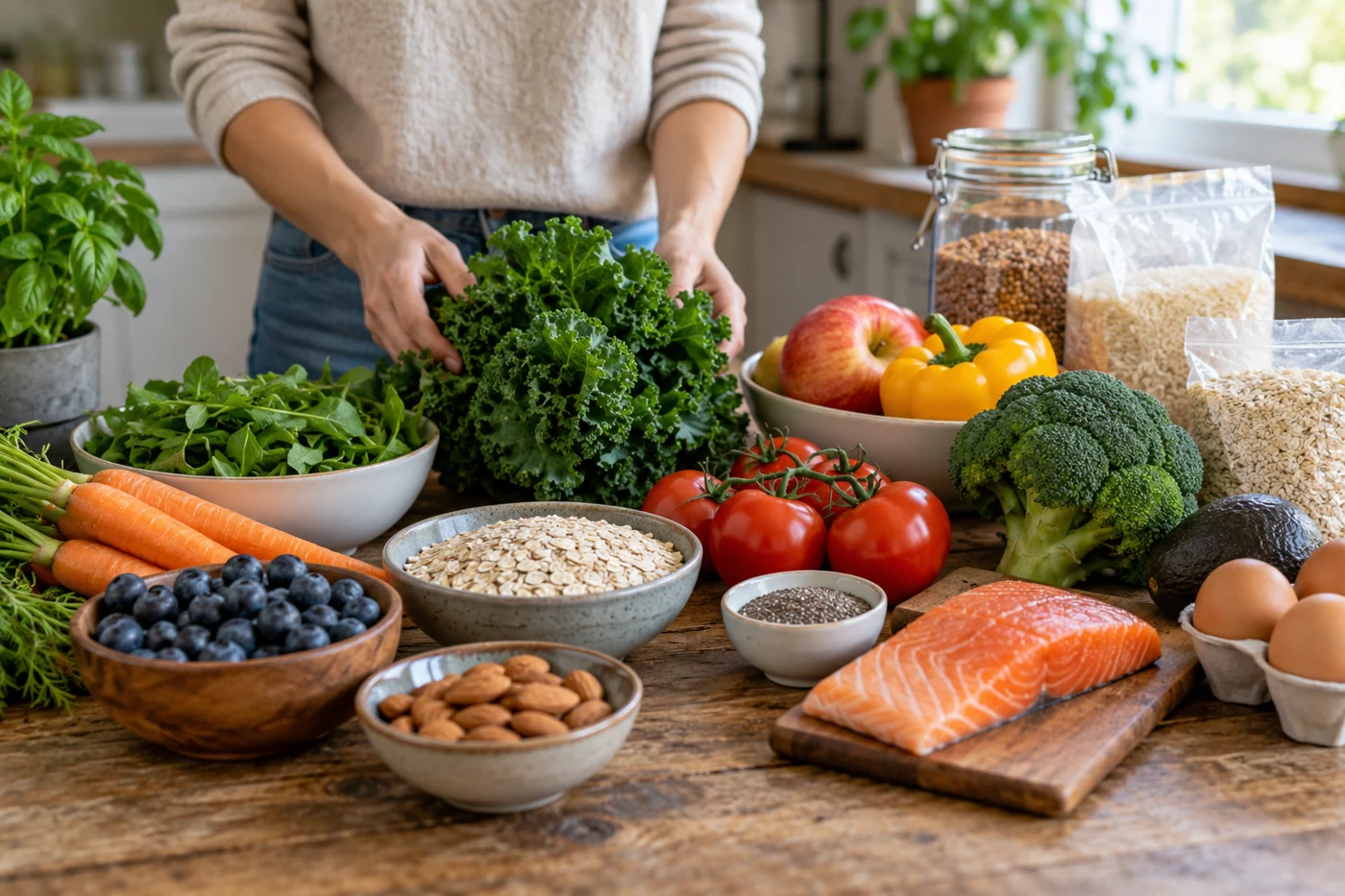
Affordable staples can carry much of this work. Plain oats, frozen vegetables, pulses and simple ingredients can be convenient without requiring a performance of culinary purity. Suitable canned foods may reduce preparation time and waste. The relevant question is how these foods fit together, not whether every preparation step happened in the kitchen.
The environment should make the desired pattern easier
People rarely make food choices in a neutral setting. Time pressure, shift work, advertising, portion sizes and the foods kept within immediate reach all shape what happens. A plan that depends on repeatedly overcoming the same friction can become exhausting. It may be more useful to change one default than to write an ambitious list of forbidden foods.
A default might be keeping a workable lunch component available, planning a meal before the most tiring part of the day, or comparing two routinely purchased products rather than auditing the entire supermarket. These are organisational examples, not clinical prescriptions. Their value is that they direct attention toward the situations where the pattern repeatedly breaks down.
There is also a social dimension. Food rules can become a way to judge other people, especially those with less money or time. A health framework should not make access problems look like character flaws. Practical improvement requires attention to the real choices available, including food safety, storage, cooking facilities and cultural preferences.
My perspective: clarity is stronger than fear
I favour an approach that reduces unnecessary friction between knowledge and action. In this context, clarity means knowing which part of the pattern deserves attention first and why. It does not mean predicting every biological consequence from an ingredient list. Certainty can feel powerful while making the underlying reasoning weaker.
Take processing seriously, keep nutrient quality in view, and examine the foods that dominate the routine. Make improvements that can survive an ordinary week. The aim is a more supportive eating environment, not a permanent state of suspicion toward food. A useful classification should sharpen judgement; it should never replace it.
Related reading
Persistent Fatigue: Find the Pattern Before Buying an Energy Solution · Protein Across the Day: A Practical Question for Healthy Ageing · Resistance Training for Healthy Ageing: Build Useful Strength · Sleep Regularity and Longevity: What the Evidence Really Shows
About the author
Gabriel Nicolaev – CyGuru writes about human regulation, nutrition and the relationship between daily structure and wellbeing. This article presents an educational interpretation of the cited evidence; no independent clinical review is claimed.
Medical note
This article is general education and does not prescribe an individual diet or treatment. Significant dietary changes should be discussed with a qualified clinician or dietitian, particularly when illness, medicines, pregnancy or nutritional vulnerability are involved.