
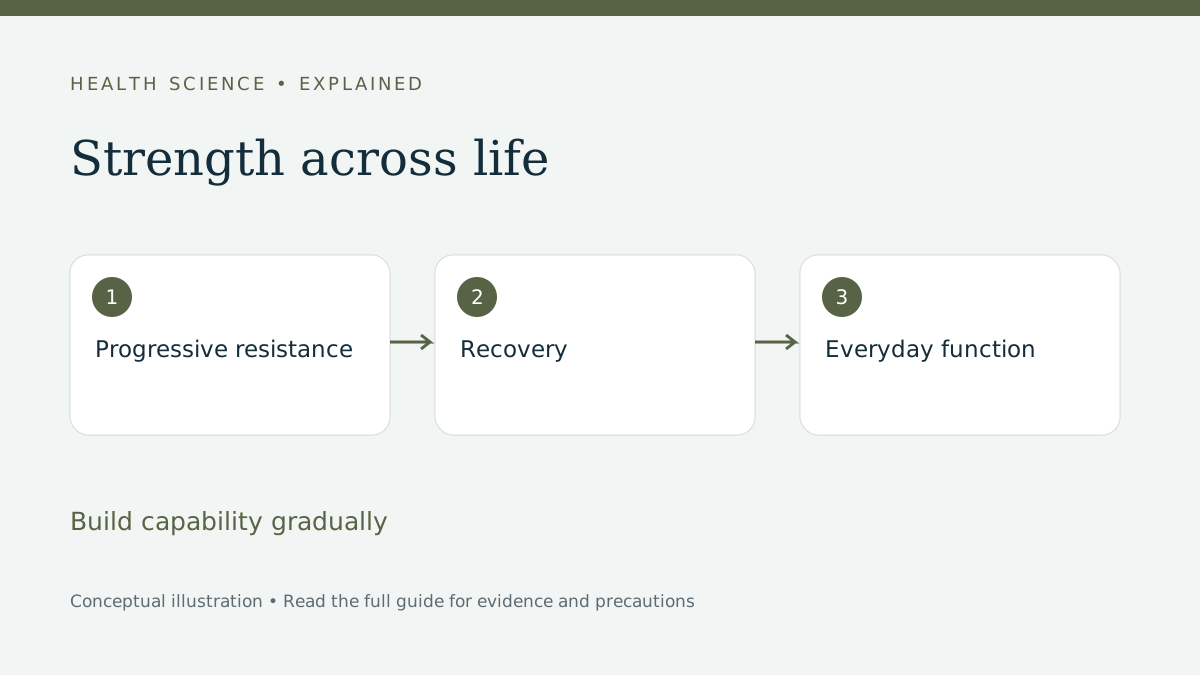
The practical value of strength becomes obvious in ordinary tasks: standing from a chair, carrying shopping, climbing steps or recovering balance after a stumble. Resistance training aims to make muscles work against a challenge so that these tasks remain manageable. The challenge can come from body weight, a resistance band, a machine or a carefully chosen free weight.
Healthy ageing does not require becoming a competitive lifter. It does require recognizing that walking and strength training make different contributions. Walking is valuable, but it does not always provide enough resistance to preserve the capacity needed for lifting, pushing and rising. A balanced routine includes several kinds of movement.
Train function, not only appearance
Muscle size, strength, power and balance are related but distinct. A person can improve how effectively they perform a task without a dramatic visible change in muscle size. Early progress may appear as better control, confidence or the ability to repeat a movement more comfortably. Those gains matter even when the bathroom scale barely changes.
Choose goals that have a direct connection to life. “Stand from my usual chair more easily” is more informative than “get fitter.” “Carry a light bag without losing posture” gives a practical task to assess. A physiotherapist or qualified exercise professional can help translate these goals into movements suited to existing limitations.
Start from current capacity
Public health guidance recommends muscle-strengthening activity on at least two days each week, alongside aerobic activity and balance work for older adults. This is a direction to work toward, not a requirement to complete a difficult routine on day one. Someone who has been inactive may need a smaller starting dose and more supervision.
A stable chair, clear floor and supportive footwear create a sensible environment. Possible movements include supported sit-to-stands, wall push-ups, gentle rowing with a band and controlled heel raises. These are examples, not a universal prescription. Arthritis, osteoporosis, recent surgery, neurological conditions or significant frailty may change which movements are appropriate.
Progress one variable at a time
Resistance training works through a repeated challenge that remains manageable. If an exercise becomes easy, progression might involve a little more resistance, an additional repetition or a slightly greater movement range. Changing everything at once makes it difficult to identify what caused discomfort or excessive fatigue.
Keep a simple record of the movement, resistance and how the session felt. That record can show gradual improvement that is otherwise easy to overlook. The goal is controlled effort, not an obligatory struggle to exhaustion. A movement performed with a manageable challenge and good technique is generally more useful than a heavier attempt that requires unsafe compensations.
Recovery is part of the programme
Muscles need time to recover from demanding sessions. Spacing sessions and paying attention to sleep, meals and hydration helps make training sustainable. Some muscle soreness may occur after unfamiliar activity, but sharp pain, joint swelling or a clear loss of function should not be dismissed as proof of a successful workout.
The distinction between effort and warning symptoms deserves attention. Breathlessness that is unusually severe, chest discomfort, dizziness or faintness warrants stopping and appropriate assessment. People with cardiovascular disease or other significant conditions should clarify exercise limits with their clinical team. Avoid holding the breath through strenuous repetitions; learn a comfortable breathing pattern with appropriate instruction.
Combine strength with balance and endurance
Strength contributes to mobility, but falls have multiple causes. Vision, medicines, footwear, environmental hazards, nerve function and balance also matter. A strength programme cannot correct every one of these factors. If someone has fallen repeatedly or feels unstable, a broader falls assessment may be more valuable than simply adding heavier weights.
Balance practice and aerobic activity complement resistance work. Depending on ability, these may include supported balance exercises, walking, cycling or supervised group sessions. The WHO emphasizes multicomponent activity for older adults, combining functional balance and strength. The right combination is the one that fits the person and can be performed consistently.
Make adherence easier than avoidance
A programme that depends on perfect motivation is fragile. Choose a realistic place and time, keep equipment accessible and identify a minimal version for busy days. Some people benefit from a class because social contact and supervision make attendance easier. Others prefer a short home routine with periodic professional review.
Avoid comparing progress with a younger person or an online demonstration. Training history, illness and medication affect what a session feels like. Compare current performance with your own starting point, using the same task and similar conditions. Small functional improvements accumulate, and consistency is often more valuable than occasional ambitious sessions.
What the evidence does not promise
Resistance exercise can improve strength and support physical function, but no programme guarantees freedom from disability or a particular lifespan. “Anti-ageing” claims often turn useful evidence into unrealistic certainty. The meaningful objective is maintaining capability, reducing avoidable limitations and participating more fully in daily life.
Review the plan when health changes. An illness, fall or operation may require temporary adaptation rather than permanent abandonment. Appropriate support can help people return gradually. The strongest programme is not necessarily the most complicated one; it is a safe, progressive routine that remains connected to the activities the person wants to keep doing.
Continue reading
Sleep Regularity and Longevity: What the Evidence Really Shows
About the author
Medicinas Editorial Team. Educational reporting on medical evidence, practical health decisions and the responsible interpretation of research.
Medical note
This article provides general education, not an individual diagnosis or treatment plan. Discuss persistent symptoms, test results and treatment changes with a qualified healthcare professional.
References
- CDC: Older adult activity overview
- WHO: Physical activity and sedentary behaviour recommendations
- US Physical Activity Guidelines
- OHSU: Resistance exercise and strength training
- NSW Government: Older adult physical activity
Continue exploring: Walking After Meals: A Useful Diabetes Habit with Individual Safety Limits.