
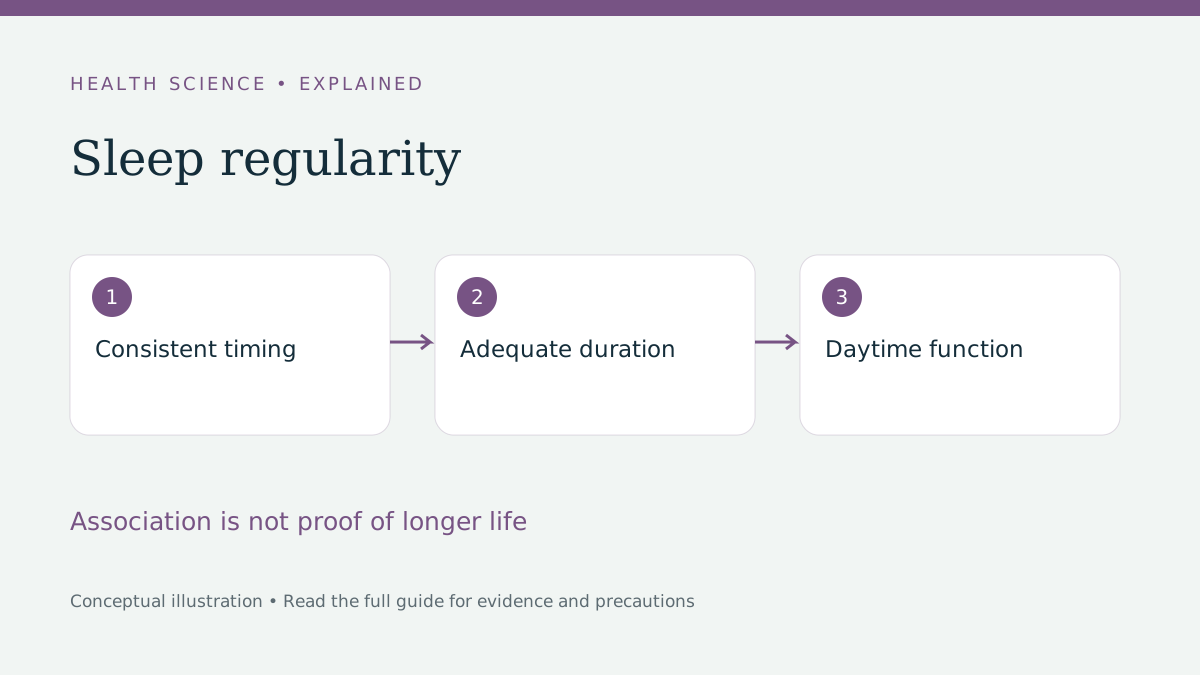
Sleep advice often begins with hours. Duration matters, but researchers increasingly study another dimension: how consistently sleep occurs from one day to the next. A person who alternates between very late nights and very early mornings may obtain an acceptable weekly average while experiencing a highly variable schedule. Regularity asks a different question from total time asleep.
This has generated strong longevity headlines. Some imply that choosing a fixed bedtime can add a predictable number of years to life. The evidence does not support that individual promise. It does support taking sleep timing seriously as one component of sleep health, alongside duration, quality and the identification of sleep disorders.
What researchers mean by regularity
Regularity can be measured in several ways, including variation in bedtimes, wake times and the probability of being asleep or awake at the same time on successive days. Research measures are not necessarily identical to a consumer watch's “sleep consistency” score. A device may use a proprietary algorithm that cannot be directly compared with a published study.
It is also important to distinguish time in bed from time asleep. Someone can follow a rigid bedtime while lying awake for hours. Another person may have a modestly flexible schedule but sleep well and function normally. A single score should therefore be interpreted as a clue about a pattern, rather than a complete judgement of sleep health.
What the mortality studies found
A prospective UK Biobank study published in Sleep analysed activity-derived sleep patterns in more than sixty thousand participants and examined subsequent mortality. Greater regularity was associated with lower mortality risk in the study's models. The investigators reported that regularity was a stronger statistical predictor than duration in their comparisons.
That phrase describes prediction within a particular dataset. It does not mean duration is unimportant, nor does it establish that changing a bedtime will produce the observed difference in risk. A separate analysis using the Multi-Ethnic Study of Atherosclerosis also investigated objectively measured regularity and survival. Together, such studies make regularity a credible research subject while leaving important causal questions open.
Association is not a prescription for extra years
People with regular sleep may differ from irregular sleepers in ways that are difficult to measure fully. Work schedules, caregiving, financial stress, illness, physical activity and medication can affect both sleep and health. Statistical adjustment reduces some confounding, but cannot guarantee that every relevant difference has been removed.
Reverse causation is another concern: developing illness can disrupt sleep before a diagnosis is made. Measurements collected over a short period may also fail to represent a person's habits over many years. These limitations do not make the findings meaningless. They define what can responsibly be concluded and explain why a precise lifespan claim would go beyond the evidence.
A practical approach without perfectionism
Begin with a schedule compatible with work, family and sufficient sleep opportunity. A reasonably consistent wake time can provide a useful anchor. Allow enough time for the amount of sleep you need rather than forcing an early wake-up after an unnecessarily late bedtime. Changes are often easier when introduced gradually.
A short diary can reveal whether variability comes from planned activities, difficulty falling asleep, night-time awakenings or sleeping late after accumulated sleep loss. Those are different problems. Record patterns for a useful period, then review them rather than tracking every minute indefinitely. The purpose is understanding, not creating another performance score to worry about.
Support the schedule with daytime habits
NHLBI guidance recommends consistent sleep and wake timing, a suitable bedroom environment and attention to habits that interfere with sleep. Daylight exposure and physical activity can support a structured day. Caffeine late in the day and alcohol used as a sleep aid may undermine the desired result, even if they seem helpful in the moment.
A calm transition toward bedtime can make the schedule easier to follow. Choose activities that are repeatable rather than elaborate. The routine might involve preparing for the next day, reducing stimulating tasks and allowing a quieter interval. It should support sleepiness, not become a ritual that makes someone feel unable to sleep unless every step is perfect.
When regularity alone is insufficient
Persistent insomnia, loud snoring with breathing pauses, marked daytime sleepiness or unusual night-time behaviour deserves clinical assessment. A regular timetable will not by itself diagnose or treat obstructive sleep apnoea. For chronic insomnia, cognitive behavioural therapy for insomnia is an established treatment approach; generic sleep-hygiene advice may not be enough.
Shift workers and caregivers face constraints that cannot be solved by discipline alone. Advice should recognize those realities and focus on feasible protection of sleep opportunity, safety and recovery. Anyone struggling to stay awake while driving should prioritize immediate safety, not attempt to compensate with a supplement or a motivational commitment to better sleep later.
Use the evidence proportionately
Regular timing is a reasonable goal because it is compatible with established sleep-health advice and may have broader benefits. It is not necessary to turn one late evening into a health emergency. A sustainable pattern allows ordinary life while reducing repeated large disruptions where possible.
The most useful outcome is better daytime function, an adequate opportunity to sleep and recognition of problems that need treatment. Longevity research can motivate those choices, but it cannot calculate the years an individual will gain. Consistency deserves attention precisely because it is practical, not because it offers a guaranteed extension of life.
Continue reading
Resistance Training for Healthy Ageing: Build Useful Strength
About the author
Medicinas Editorial Team. Educational reporting on medical evidence, practical health decisions and the responsible interpretation of research.
Medical note
This article provides general education, not an individual diagnosis or treatment plan. Discuss persistent symptoms, test results and treatment changes with a qualified healthcare professional.