Start with the question the tired body cannot answer alone
Tiredness invites quick explanations. Iron is familiar, measurable and widely sold, so it can become the first answer before the problem has been defined. Yet feeling depleted cannot tell a person whether iron stores are low, whether anaemia is present or whether another condition is responsible. The NHS identifies several possible causes of persistent fatigue and advises clinical assessment when tiredness is unexplained, prolonged or disruptive. Iron deficiency is one possibility, not a synonym for exhaustion. [1]
The more useful starting point is to describe what has changed. Is ordinary exertion harder? Have menstrual losses changed? Has food intake become restricted? Is there a new digestive problem, an existing medical condition or a medicine that needs review? These observations do not diagnose the cause, but they give a clinical conversation direction. A supplement label cannot gather this history or decide which detail matters.
I see nourishment as a relationship between provision and need. That perspective is helpful here only if it remains concrete. Providing more of a nutrient does not explain why the body became short of it. Equally, finding a cause does not make dietary support irrelevant. The strongest approach holds both questions together: how do we restore what is missing, and what must be understood so that the problem is not simply repeated?
Evidence: iron deficiency and anaemia describe different findings
Anaemia concerns the blood’s haemoglobin level relative to the appropriate laboratory and population reference. Iron deficiency concerns inadequate iron stores or availability. They often overlap, but a low haemoglobin result alone does not establish iron deficiency, and depleted stores can precede anaemia. British Society of Gastroenterology guidance recommends confirming iron deficiency with iron studies and notes that transferrin saturation can help when ferritin may appear falsely normal. [2]
Ferritin is useful because it reflects stored iron, but inflammation can raise it. NIH guidance therefore describes assessment using more than one measurement and the surrounding clinical picture. A single apparently reassuring value should not be interpreted without considering why the test was taken. Equally, a number below a reference range is not an instruction to choose a dose from an online discussion. Laboratory information supports a decision; it does not replace one. [3]
Ask the clinician which finding has actually been established and what the follow-up is intended to show. Is the aim to clarify the diagnosis, measure response or investigate recurrence? Keeping these purposes distinct reduces confusion when different tests move at different speeds. It also avoids treating every future episode of tiredness as proof that iron has fallen again. Symptoms deserve to be heard, and they still need interpretation.
Evidence: absorption is influenced by the meal, not just the iron total
Dietary iron includes haem iron from animal foods and non-haem iron found in plant foods and fortified products. Haem iron is generally more readily absorbed. Vitamin C can enhance non-haem iron absorption, while some meal components can reduce it; the importance of individual enhancers and inhibitors is less straightforward across a varied habitual diet than in isolated tests. NIH’s fact sheet is useful precisely because it places food composition within this wider context. [3]
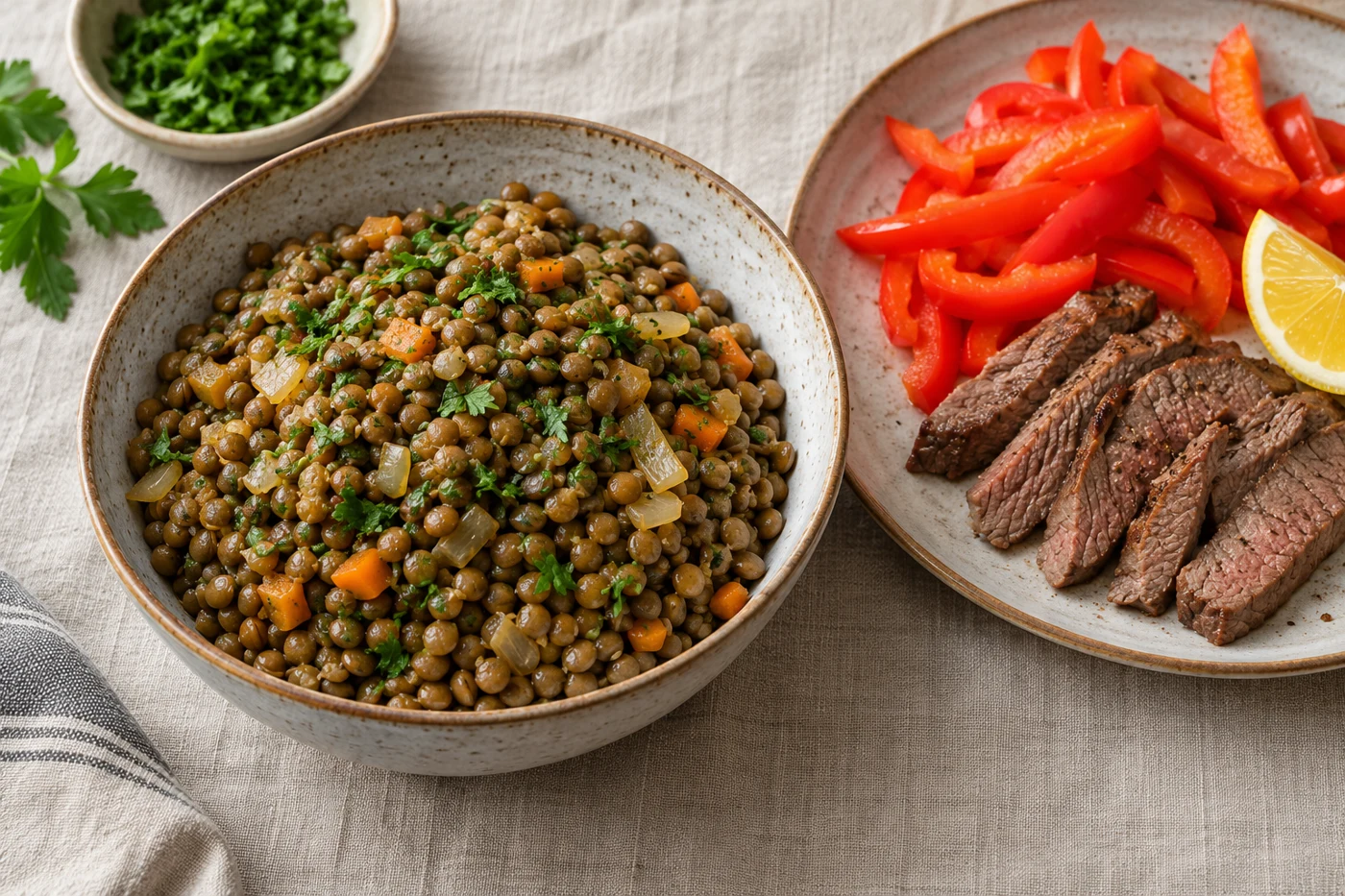
For someone eating plant-based meals, a practical combination might be lentils or beans with peppers, tomatoes or another vitamin-C-containing food. This is not a promise that a particular plate will correct deficiency. It is a way of thinking about meal construction without assuming that everyone must eat meat. Food preferences, affordability and tolerance matter when a diet has to be repeated for weeks and months rather than photographed once.
Do not let absorption advice become a growing list of forbidden foods. Whole grains, pulses and other foods can contribute valuable nutrition even when they also contain compounds that affect iron availability. The more useful conversation is about the overall pattern and, if prescribed treatment is involved, how to take that treatment according to professional advice. A balanced diet should not be dismantled in pursuit of perfect absorption at every mouthful.
Practical implications: establish the source of the deficit
Blood loss, inadequate intake and impaired absorption are different pathways to the same depleted state. NHS guidance identifies heavy menstrual bleeding and pregnancy as common contexts, and gastrointestinal bleeding as another cause. The appropriate response depends on that history. An apparently healthy diet cannot exclude ongoing loss, and a poor diet should not automatically be accepted as the complete explanation when the pattern suggests another problem. [4]
Unexplained iron-deficiency anaemia requires assessment appropriate to age, symptoms and clinical risk. Gastroenterology guidance emphasises investigation alongside replacement because significant gastrointestinal pathology can present this way. This does not mean every person with low iron has cancer. It means that reassurance should follow an adequate explanation rather than a guess. The clinician determines which investigations are appropriate; the reader’s task is to attend follow-up and understand the plan. [2]
Coeliac disease is one condition to consider in unexplained iron-deficiency anaemia. NHS guidance includes it among reasons for testing and explains that gluten needs to remain in the diet while diagnostic testing is undertaken. Starting a gluten-free diet first can make interpretation more difficult. If coeliac disease is a possibility, ask how testing should proceed before making that change. An attempt to improve digestion can otherwise obscure information needed to identify the cause. [5]
Practical implications: replacement needs a plan and a review point
When iron treatment is recommended, ask how it should be taken, what adverse effects to expect and when blood tests will be repeated. NHS guidance describes gastrointestinal side effects and the importance of follow-up. Do not silently abandon treatment because it causes discomfort, and do not assume that enduring every side effect is the only option. Reporting the difficulty gives the prescriber a chance to review the approach. Keep iron medicines securely away from children because overdose can be fatal. [4]
A food plan and a replacement plan are not interchangeable. Someone with established deficiency may need more than dietary change, while a person without deficiency may gain nothing from an iron product marketed for energy. The decision is not a judgement on the quality of the person’s diet. It is a response to the degree of deficit, its cause and the clinical circumstances. Avoid borrowing another person’s prescription or continuing an old product indefinitely without review.
Before an appointment, bring the actual packaging of supplements and a current medicine list. Include products described as natural, energy-supporting or pregnancy-related, since several may contain the same nutrient. This simple preparation helps prevent accidental duplication and makes the conversation more precise. The question is not merely whether a product contains iron, but whether that formulation, amount and schedule belong in the current care plan.
Evidence: a helpful nutrient does not make an extra supplement essential
Vitamin C is a useful example of the gap between a mechanism and an automatic treatment requirement. In a randomized trial of 440 adults with iron-deficiency anaemia, oral iron alone and oral iron with vitamin C met the study’s criterion for equivalent haemoglobin recovery. The trial does not negate vitamin C’s role in nutrition. It challenges the assumption that an additional vitamin C supplement is essential whenever iron is prescribed. [6]
That distinction can make care less complicated. A plausible explanation about absorption should not be turned into an obligation to buy several products. Ask whether an add-on is necessary for the particular situation, whether it changes an outcome that matters and whether it adds inconvenience or cost. Treatment is easier to follow when its components have a clear purpose. A longer list of supplements is not inherently a more complete response.
The same reasoning applies to claims about proprietary delivery systems or exceptionally high absorption. A claim should identify the preparation studied, the population and the outcome. A larger change in a laboratory measurement does not by itself establish greater benefit or better tolerability. Without relevant evidence, confidence in the wording of an advertisement should not outrun confidence in the clinical plan.
Limits and unanswered questions: the cause may be mixed
Some people have several contributors at once: dietary restriction, bleeding, inflammation or a chronic condition may coexist. This is one reason a simple online checklist cannot replace assessment. It is also why the first explanation may need reconsideration if the expected response does not occur. Lack of improvement should prompt review of the diagnosis and treatment experience rather than immediate blame about effort or an escalating collection of supplements.
The clinical literature offers guidance, not a promise that one schedule fits everyone. Local pathways and investigation recommendations evolve. Pregnancy, childhood, complex illness and recurrent deficiency require their own context. This article does not provide a diagnostic threshold or prescribe an iron dose because those details can be misapplied when separated from the clinical question. Ask how the result is interpreted in the laboratory and care system actually being used.
A further uncertainty concerns how much of a person’s symptoms will improve after correction. Restoring a deficiency is worthwhile, but it need not explain every difficulty. If blood results improve while fatigue persists, that is information rather than proof that treatment failed or that the person needs more iron. The next question may be different from the first. Good care allows an explanation to become more complete over time.
A more grounded way to think about restoration
The language of replenishment is attractive because it sounds complete: something is missing, so put it back. The body’s needs are more contextual. Restoration also involves understanding losses, tolerating treatment, maintaining food access and returning for review. None of these tasks requires a dramatic theory. Each can change whether an apparently straightforward plan is workable in daily life.
My broader perspective on eating invites attention to the conditions surrounding nourishment. Here that means resisting both extremes: dismissing diet because a medicine is prescribed, or dismissing investigation because a meal can be improved. Build a sustainable food pattern, follow the agreed treatment and seek reassessment when the course is unexpected. Iron should be used to answer an established need, not asked to explain every form of depletion.
Related reading
- Persistent Fatigue: Find the Pattern Before Buying an Energy Solution
- Coeliac Disease Testing: Why the Diet Change Should Wait
- Restless Legs at Night: Why the Iron Review Needs Context
- Protein Across the Day: A Practical Question for Healthy Ageing
Author and medical note
Written by Gabriel Nicolaev – CyGuru. This is general educational writing and author analysis, not a personal diagnosis or treatment plan. Discuss symptoms, treatment changes and supplement interactions with a qualified clinician. No independent medical review is claimed.
References
- NHS. Tiredness and fatigue.
- Snook et al. British Society of Gastroenterology guidelines for the management of iron deficiency anaemia in adults. Gut, 2021.
- NIH Office of Dietary Supplements. Iron: Health Professional Fact Sheet.
- NHS. Iron deficiency anaemia.
- NHS. Coeliac disease: Diagnosis.
- Li et al. The Efficacy and Safety of Vitamin C for Iron Supplementation in Adult Patients With Iron Deficiency Anemia: A Randomized Clinical Trial. JAMA Network Open, 2020.