
A nutrient relationship is not a licence to add more
Sodium and potassium are often presented as opposing characters: one to remove, the other to increase. That story is too simple for a person taking medicines, living with kidney disease or trying to make affordable meals. The practical question is not how to win a mineral contest. It is how to improve an eating pattern while respecting the body’s ability to handle what is consumed.
A lower-sodium product can be a useful choice, but its name does not reveal everything needed for safe use. Some salt substitutes replace part of the sodium chloride with potassium chloride. That changes both sides of the product. Someone who sees only the reduction in sodium may miss an important precaution. A choice that looks like a minor kitchen adjustment can therefore deserve a medicine and kidney-function conversation first.
I prefer a sequence that starts with ordinary food and ends with individualized decisions. Identify where sodium enters the day, consider workable substitutions and establish whether there is any reason to limit potassium. This is more informative than searching for a single ideal salt. The aim is a sustainable pattern, not a dramatic intervention that is followed enthusiastically before its suitability has been considered.
Evidence: sodium reduction is a population recommendation, not an isolated trick
WHO recommends that adults keep sodium intake below 2 grams daily, equivalent to less than 5 grams of salt. Sodium and salt are therefore not interchangeable units: a label or recipe can look confusing if that distinction is missed. The recommendation concerns total intake, including sodium already present in manufactured, prepared and restaurant foods, not only what is added at the table. [1]
The important implication is practical. Removing the salt shaker may have limited effect if most sodium comes from foods chosen repeatedly elsewhere. Conversely, a useful reduction need not make every meal bland. It may involve comparing bread, soup or sauce options and changing a few recurring purchases. The most productive place to begin is often a food eaten frequently, because a modest difference becomes relevant through repetition.
Population recommendations also need translation into an individual plan. A clinician may give specific advice because of a health condition, medicine or unusual fluid loss. This article does not replace that advice with a generic number. It explains the overall direction of public-health guidance and why the source of sodium matters. A target becomes useful when it helps someone make achievable choices rather than simply adding another number to worry about.
Evidence: salt substitution has clinical outcome data, with a defined context
The Salt Substitute and Stroke Study randomized 600 villages in rural China to usual salt or a substitute containing 75% sodium chloride and 25% potassium chloride. Participants had a previous stroke or were older adults with high blood pressure. Over several years, stroke, major cardiovascular events and deaths were lower in the substitute group. Serious events attributed to high potassium were not significantly increased in that trial. [2]
This is stronger evidence than a claim based only on a short-term change in blood pressure. It still needs careful interpretation. The population, diet and intervention were specific, and the result does not establish that unrestricted potassium salt is safe for every shopper. A safety finding within a study is not a guarantee for someone with a different risk profile. Both the benefit and its boundaries belong in the explanation.
WHO’s 2025 guidance conditionally suggests potassium-containing lower-sodium substitutes when adults choose to use table salt. The recommendation excludes pregnancy, children and people with impaired potassium excretion, including kidney impairment. It is part of a wider sodium-reduction strategy, not a suggestion to use unlimited quantities of the substitute. Knowing that a recommendation is conditional should lead to better questions, not dismissal of the evidence. [3]
Practical implications: learn what the label is actually comparing
In the United States, the FDA’s Nutrition Facts label lists sodium per serving and as a percentage of a daily reference value. FDA guidance describes 5% of the Daily Value or less per serving as low and 20% or more as high. Check the serving size as well as the percentage: eating two labelled servings changes the amount consumed. A percentage is a comparison tool, not an individualized prescription. [4]
Other countries may display salt per 100 grams or use different front-of-pack systems. Compare like with like. If one package gives a figure per serving and another per 100 grams, the larger-looking number may not indicate the saltier food. Pause long enough to establish the basis of the comparison. This is more useful than trusting a front label that says natural, premium or mineral-rich without quantifying what the portion contains.
Choose one shopping comparison rather than trying to audit the entire diet at once. If a soup is eaten several times a week, compare realistic alternatives and consider the portion normally used. Repeat the process with another regular item later. Keep the decision connected to price, taste and availability so that it can be maintained. Information improves nutrition only when it survives contact with the actual shopping basket.
Practical implications: potassium-rich food belongs within a dietary pattern
The DASH eating plan emphasises vegetables, fruit, whole grains, appropriate protein foods and other nutrient-rich choices while limiting sodium and saturated fat. NHLBI describes it as a pattern rich in potassium and several other nutrients. Its value is not that one banana cancels a salty meal. It provides a way to think about recurring food choices across the day rather than trying to neutralize one nutrient with another. [5]
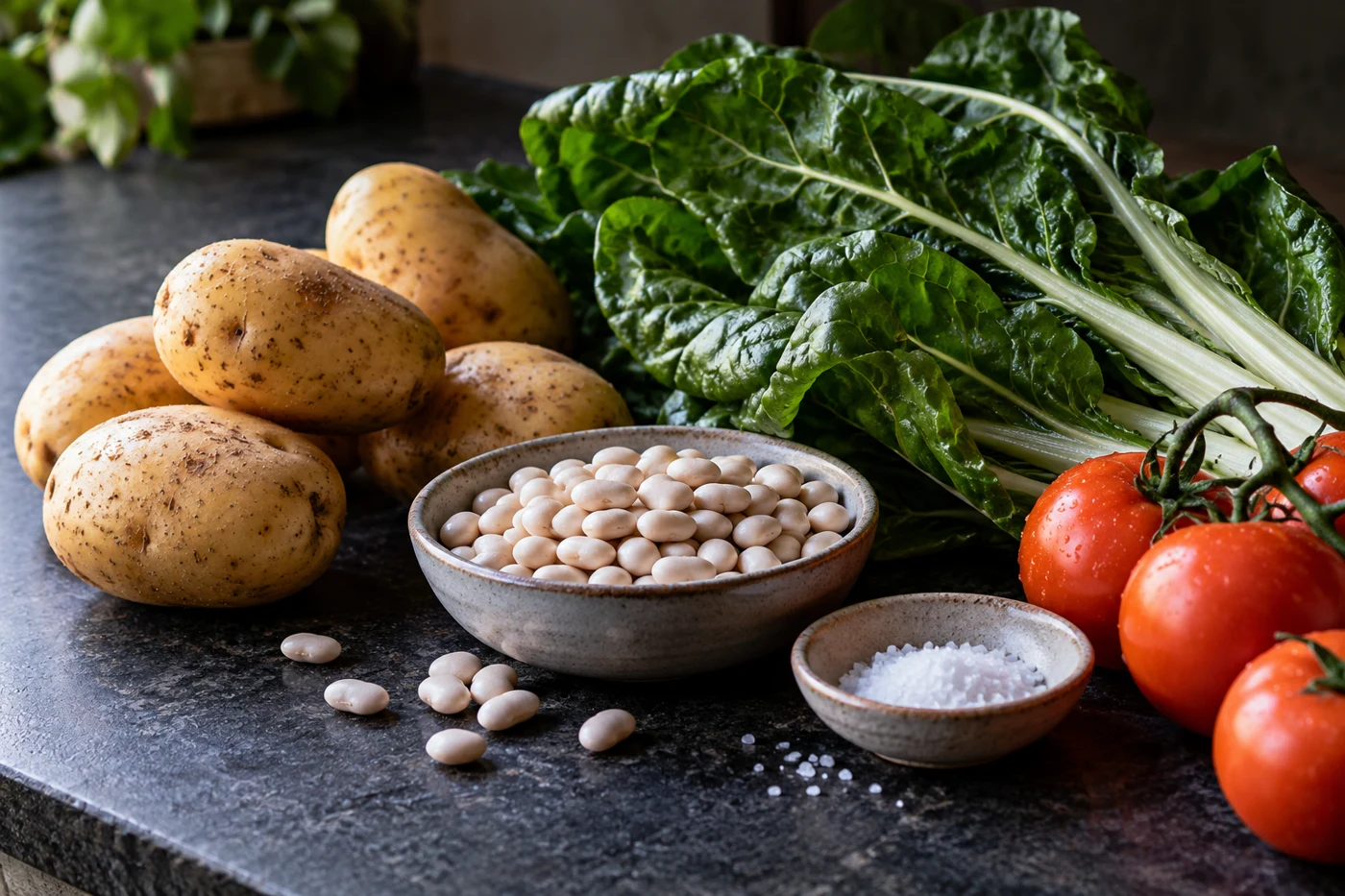
NIH guidance identifies potassium in many foods, including potatoes, legumes, fruit, vegetables, dairy and fish. That variety matters because a dietary pattern should not depend on a single supposedly essential food. If one option is unaffordable or disliked, another may fit. For a person without a potassium restriction, the conversation can begin with variety and adequacy rather than a supplement marketed as an electrolyte solution. [6]
A workable meal might combine a familiar staple with vegetables and a suitable protein food, using herbs, spices, lemon or another preferred flavouring to make a lower-sodium version enjoyable. There is no requirement to copy a menu from another culture or buy specialist wellness products. Food guidance becomes more sustainable when it adapts existing cooking habits. Make the improvement recognizable enough that the household can repeat it.
The kidney and medicine check comes before potassium substitution
The kidneys play a major role in potassium handling. NIH notes that kidney disease and medicines that reduce potassium excretion can increase the risk of hyperkalaemia. ACE inhibitors, angiotensin receptor blockers and potassium-sparing diuretics are important examples. Someone taking such a medicine should discuss potassium supplements and salt substitutes with a clinician or pharmacist rather than assuming that a food-store product cannot interact with prescribed care. [6]
Bring the actual package to that discussion. Ask whether it contains potassium chloride, whether the proposed use fits the current treatment plan and whether blood-test monitoring is relevant. Do not stop a useful medicine in order to accommodate a salt substitute. The safer response to uncertainty is to review the optional product, not to abandon established treatment. A kitchen choice should support care rather than create a competing plan.
Nor should a person with kidney disease independently eliminate every potassium-containing food. The appropriate approach depends on the clinical situation and results, and broad restriction can make eating unnecessarily difficult. Ask for individualized advice, including dietetic support when available. The point of identifying risk is precision: to know what needs adjustment and what can remain part of an adequate, enjoyable diet.
Limits and unanswered questions: better choices need an achievable setting
A nutrient recommendation cannot solve every obstacle around food. Someone may rely on prepared meals because of disability, cost, shift work or limited cooking facilities. Advice should acknowledge those conditions instead of treating them as failures of motivation. Comparing available options, using a smaller amount of a concentrated condiment or requesting a practical change when ordering can be reasonable starting points. The most useful next step is one the person can actually carry out.
Clinical trials answer specific questions about interventions in specific settings. They do not tell every household which substitution will be affordable, acceptable or safe. Nor do they establish an ideal sodium-to-potassium ratio for self-calculation at every meal. Long-term adherence, food supply and individual risk remain central. If an intervention works in principle but is not used or is used unsafely, its practical value is reduced.
There is also a communication problem when food advice is framed as a cure. Lower-sodium eating does not remove the need for blood-pressure follow-up, and potassium-rich foods do not replace cardiovascular medicines. A helpful habit can contribute to a plan without becoming the whole plan. Keeping that distinction clear allows people to improve meals while continuing the monitoring and treatment that their health circumstances require.
A more useful definition of balance
Balance is not achieved by alternating excess with compensation. It is built through repeated choices that fit both physiology and daily life. In this context, that may mean lower-sodium versions of common foods, a varied eating pattern and a deliberate check before introducing potassium salt. The process is quieter than the promise of a remarkable new ingredient, but it provides more opportunities to notice and correct a mismatch.
Within my broader perspective on eating, context means asking what surrounds a recommendation: the medicines, the kidney function, the budget and the kitchen. These are not secondary details. They determine whether advice is appropriate. Start there, and sodium and potassium become manageable questions about food and care rather than another set of numbers that a person feels compelled to control alone.
Related reading
- Home Blood Pressure Monitoring: Make the Measurement Useful
- Blood Pressure Beyond the Clinic: White-Coat and Masked Patterns
- Liquorice Root: When a Familiar Herb Changes Blood Pressure and Potassium
- High Triglycerides: Look for the Contributors Before Chasing a Number
Author and medical note
Written by Gabriel Nicolaev – CyGuru. This is general educational writing and author analysis, not a personal diagnosis or treatment plan. Discuss symptoms, treatment changes and supplement interactions with a qualified clinician. No independent medical review is claimed.
References
- World Health Organization. Sodium reduction.
- Neal et al. Effect of Salt Substitution on Cardiovascular Events and Death. New England Journal of Medicine, 2021.
- World Health Organization. Use of lower-sodium salt substitutes: WHO guideline, 2025.
- U.S. Food and Drug Administration. Sodium in Your Diet.
- NHLBI. DASH Eating Plan.
- NIH Office of Dietary Supplements. Potassium: Health Professional Fact Sheet.