
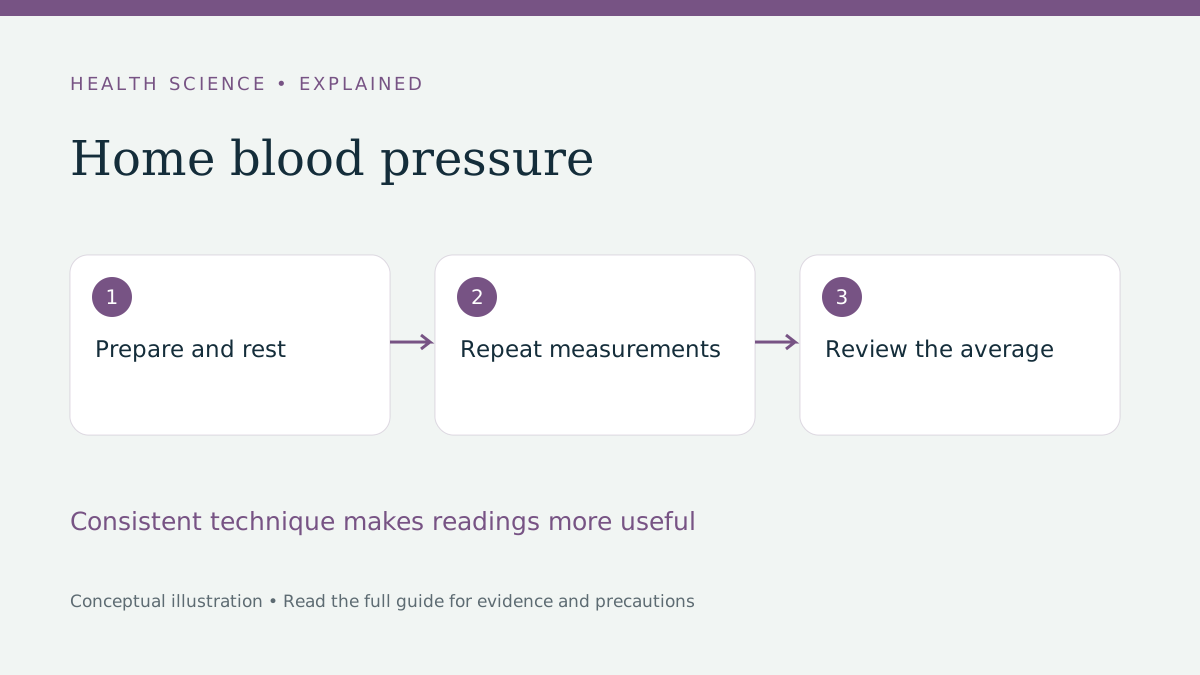
A blood pressure monitor can produce a precise-looking number even when the measurement conditions are poor. A reading taken while talking, immediately after climbing stairs, or with an unsuitable cuff may not represent resting blood pressure. The useful question is therefore not simply “What was my number?” It is “Was this measurement taken in a way that makes it comparable with the others?”
Home monitoring gives a clinician information between appointments. It can help reveal a persistent pattern, evaluate treatment and investigate differences between home and office readings. It is not a reason to change prescription doses independently. The aim is a trustworthy record that supports a decision, rather than a collection of numbers that produces anxiety.
Begin with the device and cuff
The American Heart Association recommends an automatic upper-arm device with a cuff that fits the arm. Validation matters: a monitor being sold online does not by itself establish accuracy. Choose a model validated for the intended user, with particular attention to pregnancy, children and unusual arm sizes. Bring the device to an appointment so its use and readings can be checked.
Measure arm circumference according to the manufacturer's instructions before choosing the cuff. Do not assume a cuff labelled “standard” fits everybody. Read the instructions for placement, storage and maintenance. If several people share the device, keep their records separate; otherwise a clinician may interpret a mixed set as one person's pattern.
Create repeatable resting conditions
Before measuring, avoid smoking, caffeine and exercise for approximately thirty minutes and empty your bladder. Sit quietly for at least five minutes. Place both feet flat on the floor, support your back, and rest the bare arm on a surface so the cuff is at heart level. Avoid talking or using a phone during the measurement.
These details are not ceremonial. A blood pressure reading is a physiological observation made under specific conditions. Keeping those conditions stable makes changes easier to interpret. A small table and a comfortable chair can be more useful than taking readings in whichever room happens to be convenient. If physical limitations make the usual position difficult, ask the clinical team for a consistent alternative.
Use a plan rather than repeated reassurance checks
Ask the clinician when to measure and for how many days. A common approach uses two readings, about a minute apart, at each session, with sessions at consistent times. Follow the agreed protocol rather than choosing only the lowest result. Keep date, time, both readings and relevant notes, such as missed medication or an unusually poor night of sleep.
Do not continue inflating the cuff indefinitely until a preferred number appears. Repeated checking can create a cycle in which worry prompts more measurements and each result becomes harder to interpret. If the first reading is unexpectedly high, check your position, rest, and follow the agreed repeat-measurement instructions. Persistent elevation deserves clinical review even when you feel well.
Understand what the record can and cannot show
Blood pressure changes across the day. A single measurement cannot describe the entire pattern, and a normal home reading does not erase consistently high values elsewhere. Conversely, a high office reading may need comparison with home or ambulatory monitoring. A clinician can assess whether the difference reflects the measurement setting, medication timing, technique or a clinically important pattern.
The diary should support a conversation about averages and circumstances. Write down symptoms rather than trying to explain them yourself. Dizziness after standing, headaches or palpitations may require separate assessment; a normal pressure reading does not establish their cause. A monitor also cannot substitute for an examination, kidney testing or cardiovascular risk assessment when these are indicated.
Know the urgent-action boundary
If a reading is above 180 systolic and/or 120 diastolic, wait at least a minute and repeat it. If it remains that high, contact a healthcare professional promptly. If very high pressure occurs with chest pain, shortness of breath, weakness, numbness, vision changes or difficulty speaking, seek emergency help immediately. Do not wait for a routine appointment or try a supplement first.
An emergency can also occur without a home reading crossing a particular threshold. Sudden stroke-like symptoms or severe chest discomfort require urgent attention on their own. The purpose of a threshold is to guide action, not to offer reassurance when serious symptoms are present.
Make the next appointment more productive
Bring the monitor, its cuff, the record and an up-to-date medication list. Useful questions include whether the cuff is correct, whether the home target differs from the clinic target, which average should guide decisions, and what changes should trigger a call. Ask how the plan should work during illness, travel or a change in treatment.
A good monitoring routine should become simple enough to maintain. It does not require constant surveillance. Reliable technique, an agreed schedule and a clear response plan turn home measurements into useful clinical information. The best result is not a perfect-looking diary; it is better understanding and safer management.
Continue reading
LDL Cholesterol and ApoB: Two Different Questions About Risk · When HbA1c Does Not Match Glucose: Understanding the Limits
About the author
Medicinas Editorial Team. Educational reporting on medical evidence, practical health decisions and the responsible interpretation of research.
Medical note
This article provides general education, not an individual diagnosis or treatment plan. Discuss persistent symptoms, test results and treatment changes with a qualified healthcare professional.