
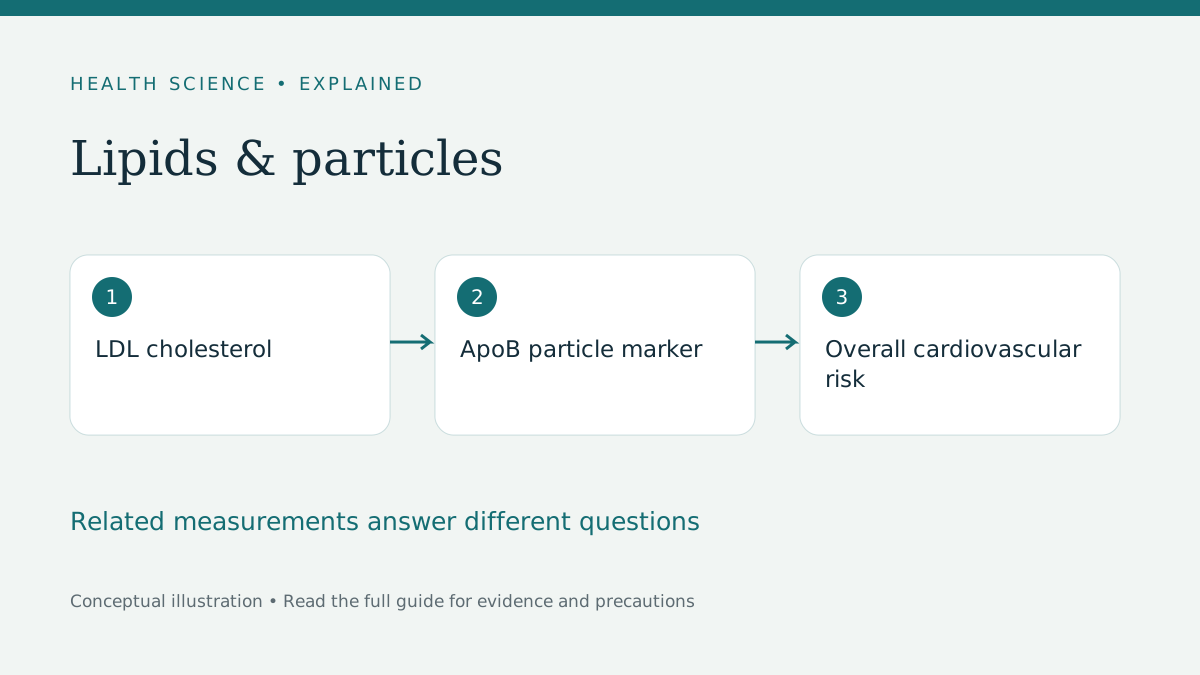
Two people can have similar LDL cholesterol results and still carry different numbers of cholesterol-transporting particles in their blood. This helps explain why a clinician may request apolipoprotein B, usually shortened to ApoB, after reviewing a standard lipid panel. The additional test is not a claim that conventional cholesterol testing is useless. It addresses a related but different question.
LDL cholesterol, or LDL-C, describes cholesterol carried within LDL particles. ApoB helps estimate the number of atherogenic particles. Thinking separately about cargo and carriers makes apparently contradictory results easier to understand. The distinction becomes clinically useful when the cholesterol content of those particles varies.
Cholesterol travels in particles
Cholesterol is needed for normal biology, but it does not dissolve freely in blood. Lipoprotein particles transport it along with other lipids. LDL particles are one important class. When particles capable of contributing to atherosclerosis enter and are retained in artery walls, they participate in a process that can eventually produce plaque and cardiovascular events.
A conventional panel commonly reports total cholesterol, HDL cholesterol, LDL cholesterol and triglycerides. Non-HDL cholesterol is total cholesterol minus HDL cholesterol. It captures cholesterol across several potentially atherogenic particle classes, rather than LDL alone. These measurements remain useful and should be interpreted alongside the person's medical history, not treated as competing scores in a contest.
What ApoB adds
ApoB is a structural protein carried by atherogenic lipoproteins. Because each relevant particle carries an ApoB molecule, measuring ApoB provides information about particle burden. The National Lipid Association's expert consensus describes particular value when ApoB and LDL-C disagree. In such circumstances, ApoB may better reflect the risk associated with the number of particles.
A simple conceptual example is two deliveries containing the same total quantity of cargo: one might use a few heavily loaded vehicles, the other many lightly loaded vehicles. That analogy explains the measurement distinction, but arteries are not roads and an analogy cannot set a treatment target. The actual clinical interpretation depends on measured results and the person's overall risk.
Why disagreement happens
The lipid content of particles varies. In some metabolic settings, including elevated triglycerides, LDL particles may carry less cholesterol per particle. LDL-C can therefore appear less concerning than the particle number suggested by ApoB. This situation is often called discordance. It is a reason to look more carefully, not evidence that the laboratory has necessarily made an error.
Before drawing conclusions, compare dates, units and treatment status. Results obtained before and after a medication change should not be treated as simultaneous observations. A report may use milligrams per decilitre or different local units; copying a target from another website without checking the unit can create a major misunderstanding. Ask the clinician to explain the actual report rather than interpreting a screenshot in isolation.
One marker cannot summarize the whole person
Age, blood pressure, smoking, diabetes, kidney disease, family history and previous cardiovascular disease all matter. The same lipid value may lead to different recommendations in someone who has already had a heart attack and someone with no known vascular disease. Clinical decisions depend on absolute risk as well as the measurement itself.
ApoB also does not remove the need to consider other lipid disorders. Lipoprotein(a), severe hypertriglyceridaemia and unusual inherited conditions may require separate evaluation. A reassuring ApoB result cannot be used to dismiss symptoms or every other abnormality on a lipid panel. Similarly, a high result is not a diagnosis of an imminent heart attack.
Use the result to improve decisions
A useful discussion begins with why the test was requested. Is it intended to clarify residual risk, assess a discordant panel, or monitor response to treatment? Next ask whether the result changes the plan. More information has value when it improves a decision; ordering every available biomarker without a question can produce expense and confusion.
Dietary patterns, physical activity and prescribed lipid-lowering medicines may all be relevant, depending on the individual. Do not stop a statin because a supplement advertisement promises a more natural approach, or assume a product has proven cardiovascular benefits because it changes one laboratory number. Evidence for reducing cardiovascular events is a different standard from evidence for altering a biomarker.
Prepare for a focused review
Bring previous lipid reports, a medication list and the ages at which close relatives developed premature cardiovascular disease. Record major recent changes in health, weight or treatment. If the clinician recommends repeat testing, clarify timing and whether fasting is needed for that particular assessment. Laboratories and clinical situations differ, so follow the instructions you receive.
The practical goal is not to choose a favourite test. LDL-C describes cholesterol concentration in LDL, while ApoB adds information about atherogenic particle burden. Used together with non-HDL cholesterol and the broader clinical picture, they can make prevention more precise. Used without context, either can become a misleading label.
Continue reading
Home Blood Pressure Monitoring: Make the Measurement Useful · When HbA1c Does Not Match Glucose: Understanding the Limits
About the author
Medicinas Editorial Team. Educational reporting on medical evidence, practical health decisions and the responsible interpretation of research.
Medical note
This article provides general education, not an individual diagnosis or treatment plan. Discuss persistent symptoms, test results and treatment changes with a qualified healthcare professional.