
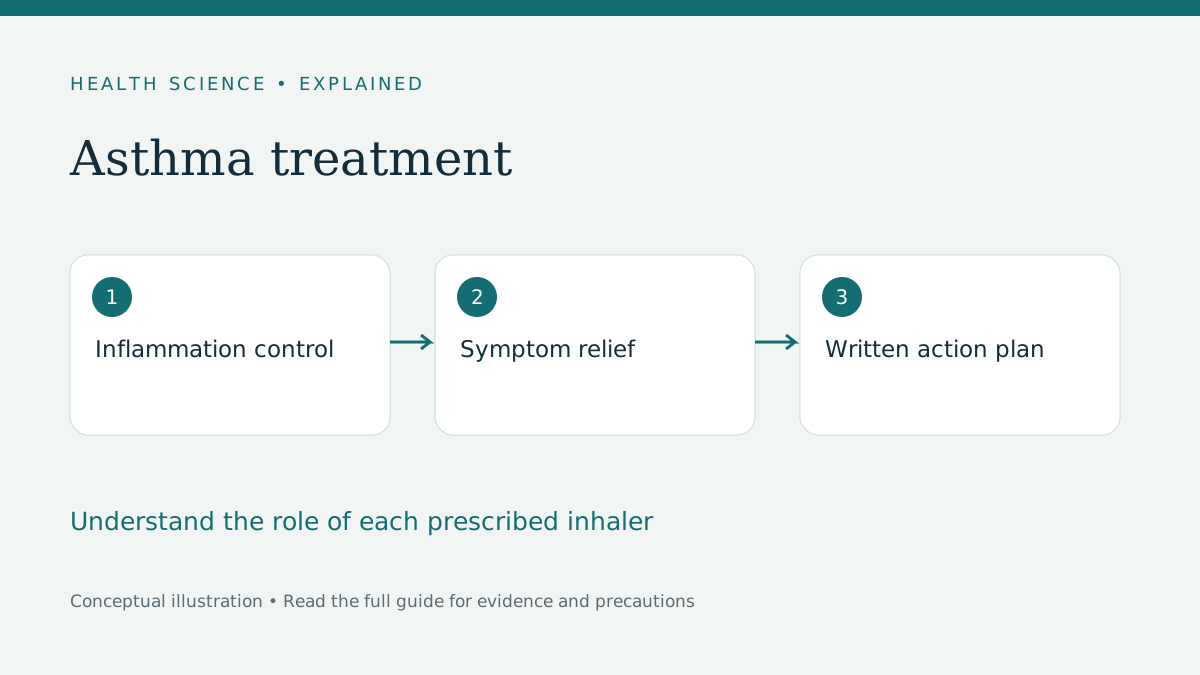
Asthma treatment is easier to understand when two goals are separated: relieving symptoms now and reducing the chance of symptoms and attacks later. These goals overlap, but they are not identical. An inhaler that quickly makes breathing feel easier does not necessarily provide all the anti-inflammatory treatment a person needs.
The traditional language of preventer and reliever remains useful, yet modern treatment may place both functions in one prescribed inhaler. This is why identifying a medicine by its colour alone can cause confusion. The active ingredients, device and written instructions are more reliable than assumptions about what a blue, brown or red inhaler must do.
Airway opening and inflammation are different targets
Asthma involves variable airway narrowing and inflammation. Bronchodilators help open airways; inhaled corticosteroids address inflammation. The presence of two treatment targets explains why symptom relief and disease control should be reviewed separately. A person may feel a rapid benefit from a reliever while still having substantial risk of future problems.
NHLBI describes both quick-relief and long-term control medicines, with treatment chosen according to age, severity and response. Additional medicines may be appropriate for selected patients whose asthma remains difficult to control. The existence of several options should not lead to self-selection from a list: diagnosis, technique and adherence need review before a regimen is changed.
An inhaled corticosteroid is not the same situation as repeatedly needing courses of steroid tablets. Dose, route and duration affect both benefits and risks. If fear of the word steroid is leading to skipped doses, discuss the concern directly rather than silently changing the prescription.
Why some inhalers serve both purposes
Current NHS guidance describes anti-inflammatory reliever therapy, often called AIR, and maintenance and reliever therapy, called MART. These use suitable combination inhalers in specified ways. In MART, the same prescribed inhaler provides regular maintenance treatment and additional relief when needed. That can simplify a regimen, but only when the exact product and instructions support it.
Not every combination inhaler can be used as a reliever. Do not borrow a relative's device or add extra doses of a maintenance-only medicine because another product is used that way. A change from one regimen to another needs clear instructions about which previous inhalers are stopped, which remain and what maximum use requires urgent advice.
Children and adults may have different treatment pathways, and available products differ between countries. An online article should therefore help readers ask better questions rather than prescribe a universal inhaler schedule. Follow the individual action plan and the current instructions from the treating team.
Technique is part of the dose
An inhaler can contain the right medicine while delivering too little to the lungs because the technique does not match the device. Asthma + Lung UK emphasises reviewing the device and how it is used. A pressurised inhaler, a dry-powder inhaler and a soft-mist device do not all require the same breathing pattern or preparation steps.
Ask a pharmacist or nurse to watch a complete demonstration using the actual device. Explain any problem with coordination, grip, reading the dose counter or knowing when the inhaler is empty. A compatible spacer can be useful with certain devices, but it is not attached indiscriminately to every inhaler type.
Also ask about cleaning, storage and mouth care after steroid-containing inhalers. These small practical details can affect how consistently treatment is used. A device that is technically effective but impossible to operate reliably needs attention, not blame.
What the action plan should settle
CDC recommends an individual asthma action plan. It should make ordinary daily care and worsening symptoms understandable before an attack occurs. A usable plan identifies medicines, doses, warning signs, the next steps when control worsens and the circumstances requiring emergency care. Some plans incorporate peak-flow readings; the clinician should explain the person's own thresholds.
Review the plan after a treatment change or significant flare-up. Keep a current copy accessible and share relevant instructions with people responsible for a child's care. A plan stored somewhere nobody can find during a problem has less practical value than a clear page kept with the medicines.
Track patterns worth discussing: nighttime waking, activity limitation, increased reliever use and episodes requiring urgent treatment. Record what happened rather than simply rating asthma as good or bad. This makes a consultation more informative and helps distinguish a device problem from a trigger or a changing disease pattern.
When relief is not enough
Severe breathing difficulty, difficulty speaking because of breathlessness, exhaustion, confusion or symptoms not responding to the prescribed rescue plan require emergency help. Follow the action plan while obtaining help; do not wait for a supplement, steam treatment or breathing exercise to replace urgent treatment.
For stable asthma, exercise and trigger management can support daily functioning, but herbs do not replace prescribed inhalers. Nasal allergy may also need attention; see our allergic rhinitis guide. The aim is an understandable regimen that allows normal life with fewer symptoms and lower risk, reviewed whenever the actual experience no longer matches that aim.
Continue reading
A Cough After a Cold: Recovery, Reassessment and Warning Signs · Allergic Rhinitis: Matching Sprays, Rinses and Trigger Control to Symptoms
About the author
Medicinas Editorial Team prepares educational articles by comparing clinical guidance and research with practical questions readers bring to everyday health decisions.
Medical note
This article provides general education, not a diagnosis or an individual treatment plan. Discuss persistent symptoms, medicines and supplement choices with an appropriately qualified clinician or pharmacist.