The human body is electrical in an important, measurable sense. Nerve cells change voltage, muscle cells respond to electrical signals, and the heart coordinates contraction through a specialised conduction system. These are not metaphors. They are processes studied through physiology and used in clinical practice.
The difficulty begins when that accurate statement is asked to support an unlimited conclusion. The existence of membrane voltage does not show that every feeling is a frequency, that disease is a low charge state, or that a practitioner can diagnose and repair illness by manipulating an unspecified field. I want to keep the wonder of bioelectricity while making the boundaries of the evidence more precise.
Voltage is a relationship across a membrane
A cell membrane separates environments with different distributions of charged particles, or ions. The voltage across that membrane reflects those distributions and the membrane's permeability. It is a potential difference, measured between locations, rather than a single number describing the energy of the whole person.
This distinction matters when a commercial explanation says that the body should maintain one ideal voltage. Cells differ, tissues perform different functions, and membrane potentials change with activity. A meaningful measurement needs a defined location, method and reference. Without those details, a number may sound scientific while describing nothing that can be reliably tested. The correct response is to ask what exactly was measured and what a validated result would mean.
Channels and pumps create organised behaviour
Ion channels allow particular charged particles to cross a membrane under particular conditions. Some respond to voltage, some to chemical signals and some to other influences. Transport mechanisms help maintain the gradients that make cellular signalling possible. The system is active, regulated and highly specific.
It is therefore misleading to imagine a nerve as a simple household wire or the entire organism as a rechargeable battery. Those analogies can help introduce one feature, but they conceal others. Cells use chemical energy to maintain ion distributions, membranes restrict movement, and signals depend on organised opening and closing of pathways. A useful analogy should lead back to the mechanism rather than taking its place.
An action potential is an event, not an emotional label
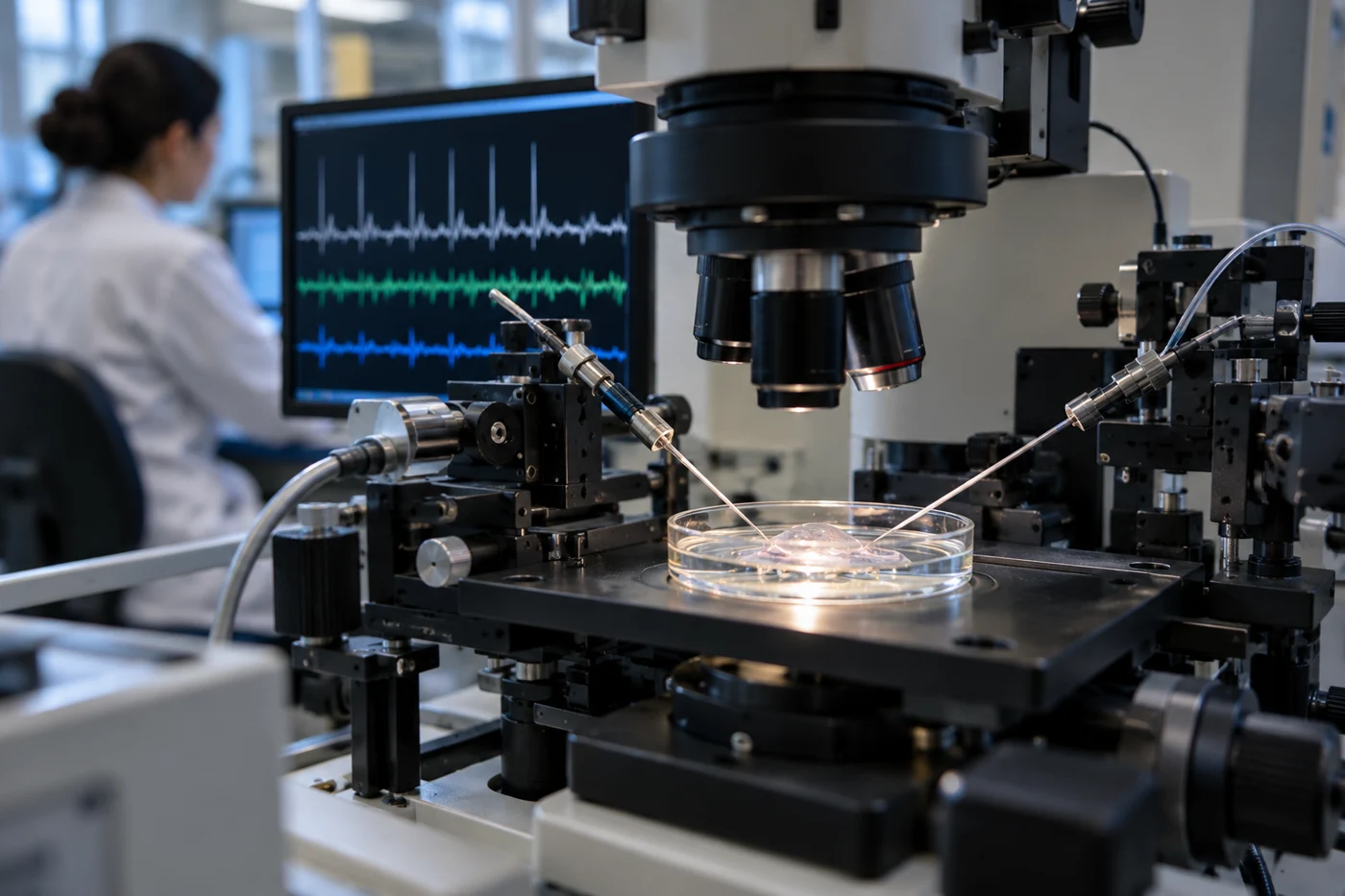
In excitable cells, a sufficiently strong change can initiate an action potential: a rapid sequence of membrane-voltage changes involving ion conductances. In nerves, this allows information to propagate along an axon. The details differ among cell types, and communication also depends on synapses and broader networks.
Calling sadness or confidence a frequency does not identify those details. An emotional state involves patterns of activity, bodily responses, interpretation and context; it is not captured by assigning the person a single spiritual vibration. If frequency is being used as a metaphor, that should be stated. If it is being presented as a measurable clinical variable, the method, units and relationship to meaningful outcomes must be supplied.
Electrical tests answer specific clinical questions
An electrocardiogram records patterns associated with the heart's electrical activity at the body surface. It can help clinicians investigate rhythm and conduction problems. The test is useful because it has a defined method, recognisable patterns and a clinical interpretation connected with symptoms and other findings.
It does not measure moral alignment, emotional purity or the total charge of the body. Nor does an abnormal tracing automatically reveal one diagnosis without context. The value of established electrical medicine lies in its specificity. The measured signal is connected to a defined physiological process and interpreted within a clinical pathway, not used as a universal explanation for every symptom.
Electrical treatment requires more than an electrical story
Pacemakers are an example of an intervention designed for particular rhythm problems. Their use involves selecting an appropriate indication, placing and programming a device, and checking how it interacts with the patient's heart. Follow-up matters because the therapeutic effect depends on the relationship between the device and the individual physiological problem.
The existence of a successful electrical medical treatment does not establish that an unrelated device or practice works. Evidence cannot be transferred merely because both descriptions contain the word energy. Ask whether the proposed intervention delivers a defined exposure, whether it reaches the intended target, and whether controlled studies show benefit for the condition being discussed. Device appearance, technical vocabulary and enthusiastic testimony do not answer those questions.
Research findings have a level of application
Bioelectric processes are also studied in development, tissue organisation and disease. Mechanistic research can reveal previously overlooked relationships and create valuable hypotheses. A result in cells or an experimental model, however, is not automatically a treatment for a person. The route from observation to clinical use requires additional testing.
The relevant questions are practical: does changing the measured variable alter an important outcome, can the change be produced safely, and does the benefit persist under realistic conditions? A mechanism may be real while a proposed therapy remains unproven. Keeping those two statements together is a mark of scientific accuracy, not a refusal to explore new ideas.
Distinguish a calming encounter from a field mechanism
Some people find a quiet therapeutic encounter relaxing. Attention, expectation, touch where appropriate, reduced stimulation and time away from ordinary demands can all shape an experience. A person reporting calm deserves to be heard. The reported experience does not by itself identify an invisible energy transfer as its cause.
NCCIH states that Reiki has not been clearly shown effective for a health-related purpose and that there is no scientific evidence for the proposed energy field. This does not require denying that someone felt better during a session. It requires avoiding a stronger claim than the observation supports. Feeling soothed, changing a symptom score and treating an underlying disease are different outcomes, each needing appropriate evidence.
Demand an operational definition
When an explanation uses terms such as coherence, charge or frequency, ask how they are defined. Is coherence a metaphor for a manageable routine, a mathematical relationship between signals, or a claim about an unmeasured field? A conversation becomes clearer when the same word is not allowed to move silently between those meanings.
A measurable claim should permit the possibility of being wrong. What result would count against it? Can independent observers obtain the same measurement? Does the method distinguish people with and without the condition? If every possible outcome is described as confirmation, the explanation cannot guide clinical decisions. Its language may still have personal or philosophical value, but that value should not be confused with diagnostic accuracy.
Keep safety attached to the actual intervention
The risks of an intervention depend on what it does, what it delays and what it costs. A quiet relaxation practice may have a different risk profile from a device applying electrical stimulation, an implanted device or an instruction to stop medicine. Even an apparently gentle approach can be harmful if it postpones necessary assessment or creates a false promise of disease control.
Discuss complementary practices and devices with the relevant clinician, especially when an implanted cardiac device or a serious medical condition is present. Do not assume that natural language means no interaction or that a product sold for home use requires no precautions. The clinical question is specific to the exposure and the person, rather than to the reassuring category in which the seller places it.
A responsible place for the language of energy
In everyday speech, energy often means the capacity to act, concentrate or participate. That language can be useful when it helps someone describe a real difficulty. In physiology, energy and electrical potential have more precise meanings. Responsible writing keeps these levels visible instead of using one to claim authority for another.
Within my author framework, I may discuss regulation or coherence as ways of organising attention to the whole person. These are perspectives for inquiry, not proof that an energy-healing intervention works. Measurable bioelectricity is already extraordinary: organised cells maintain differences, communicate and coordinate complex behaviour. We do not need to add unsupported promises to make it important. The strongest explanation preserves curiosity while remaining specific about what is known, what is being investigated and what has not yet been demonstrated.
Related reading
The Frequency of Love – The Ultimate Healing Vibration · The Human Aura – How the Biofield Stores Information, Emotion, and Memory · Heart Rate Variability and Stress: Read the Signal Without Becoming Its Prisoner · Panic and Autonomic Arousal: Understanding the Alarm Without Ignoring the Body
About the author
Gabriel Nicolaev – CyGuru writes about health, human behaviour and integrative perspectives. This article distinguishes clinical evidence from interpretation and does not claim independent medical review.
Medical note
This article is educational. It does not diagnose an individual, prescribe treatment or replace advice from an appropriately qualified clinician. Discuss persistent symptoms and changes in care with your clinical team.
References
- NCBI: Physiology of resting membrane potential
- NCBI: Physiology of action potentials
- NCBI: Ion channels and electrical properties of membranes
- NCBI: Ionic basis of action potentials
- NHLBI: Heart tests
- NHLBI: Cardiac conduction disorders
- NHLBI: After getting a pacemaker
- NCCIH: Reiki
- NCI: Complementary and alternative medicine