
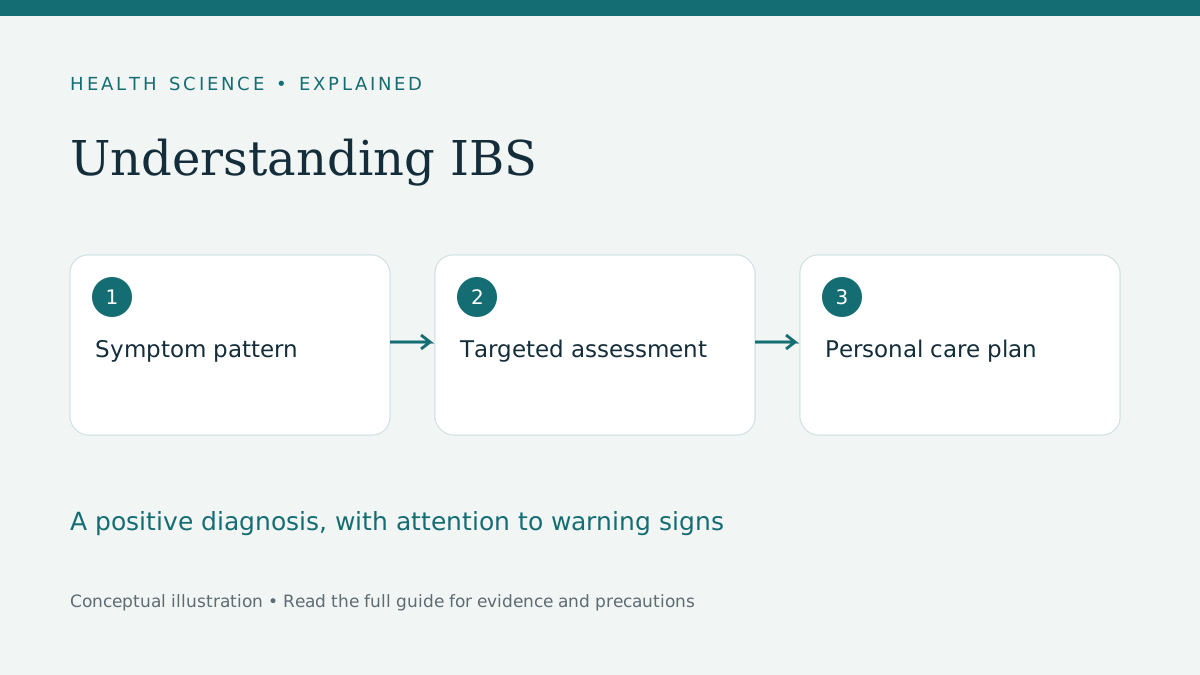
IBS is a positive clinical assessment
Irritable bowel syndrome, or IBS, involves recurrent abdominal pain associated with changes in bowel habits. Some people mainly experience constipation, others diarrhoea, and some alternate between the two. Bloating can be prominent. The symptoms are real even when routine examination or tests do not reveal visible structural damage. Calling it a disorder of gut-brain interaction describes part of the biology; it does not mean the problem is imagined.
Diagnosis should not be reduced to saying that nothing else was found. Clinicians look for a coherent symptom pattern, examine the patient and select investigations according to the history. That approach can avoid both careless reassurance and an endless search for increasingly obscure tests. The appropriate investigation for a young adult with a stable pattern may differ from that for someone with new symptoms later in life.
Describe pain and bowel changes together
Before an appointment, record where the pain occurs, how frequently it appears and whether bowel movements change it. Note stool consistency as well as frequency: three difficult, hard stools and three loose urgent stools represent different experiences. Include urgency, straining, incomplete emptying and the effect on work, travel or sleep. A brief diary is usually more useful than trying to remember months of fluctuating symptoms.
Also record medications, recent infections, family history and any previous test results. Bring the actual reports when possible rather than only remembering that they were normal. Symptoms after meals may suggest a useful pattern but do not prove food allergy or a specific intolerance. Avoid removing several major food groups before the initial assessment, because doing so can make both nutrition and interpretation more complicated.
What targeted tests can and cannot tell you
Depending on the presentation, clinicians may use blood tests, stool tests or other investigations to look for alternative explanations. Coeliac disease, inflammatory bowel disease, infection and other conditions can overlap with parts of the symptom picture. Colonoscopy is not automatically required for every person with typical IBS symptoms; the decision depends on age, warning signs, screening needs and clinical judgment.
Ask what a test is intended to answer and what the result would change. A broad commercial microbiome report cannot, by itself, establish IBS or determine an individual treatment plan. Detecting a bacterium is not the same as proving it caused the symptoms. A useful result has a validated interpretation and an action that fits the person being assessed.
Warning signs should reopen the assessment
Blood in stool, unexplained weight loss, persistent fever, anaemia or a substantial unexplained change in bowel habit should be discussed promptly. Severe or worsening abdominal pain, dehydration or significant bleeding can require urgent care. A known diagnosis of IBS should not become a reason to ignore a new pattern. Symptoms can change because a second condition has developed.
The safest plan includes instructions about what is expected and what is not. Ask when to return if an initial treatment does not help and which changes warrant earlier review. Reassurance is more useful when it is specific: a clinician can explain why the pattern fits IBS while also defining the limits of that conclusion.
Management should match the dominant problem
Treatment can involve dietary adjustments, medicines and therapies that address gut-brain interaction. The plan for predominant constipation differs from the plan for predominant diarrhoea. Some people benefit from a structured dietary trial, including a low-FODMAP approach supervised by a suitably trained professional. Such a trial should include assessment and reintroduction rather than indefinite restriction of every potentially troublesome food.
Regular meals and a manageable daily routine can provide a stable background for testing changes. Change one factor at a time when practical and agree on a meaningful outcome, such as less urgency during the commute or fewer days limited by pain. Improvement does not require perfect symptom elimination to be valuable. Equally, a treatment that makes eating increasingly restrictive may need reconsideration even if one symptom improves.
The microbiome is relevant without explaining everything
Microbiome research is an important part of the IBS field, but there is no single universal bacterial pattern that explains all cases. Findings from a study group do not automatically identify the mechanism in one individual. Probiotic effects, when present, depend on the strain, formulation and clinical setting; the word probiotic is not a guarantee of benefit.
A product trial should have a reason, a duration and a stopping rule. Keep the label and discuss it with a clinician or pharmacist, especially when other conditions or medicines are involved. Do not treat worsening symptoms as proof that the body is detoxifying. The practical objective is a tolerable, evidence-informed plan rather than accumulating supplements whose separate effects cannot be distinguished.
Make the next appointment more productive
Prepare three questions: does the current pattern fit IBS, is further investigation needed, and what should the first treatment trial achieve? Bring a short symptom record and a list of foods or products already restricted. This allows the consultation to move beyond the general statement that the stomach is sensitive.
For related explanations, read our guide to fibre and constipation and our lactose intolerance guide. These conditions and symptoms can overlap, but they should not be treated as interchangeable. An accurate explanation helps preserve both confidence in eating and attention to changes that genuinely need reassessment.
Continue reading
Constipation and Fibre: Why Type and Pace Matter · Lactose Intolerance: Keeping Nutrition Without Guesswork
About the author
Medicinas Editorial Team prepares educational articles that distinguish established clinical knowledge from emerging hypotheses.
Medical note
This article provides general information, not an individual diagnosis or treatment plan. Discuss persistent or changing symptoms with a qualified healthcare professional. Seek urgent care for the warning signs described above.
References
Continue exploring: Microbiome Stool Tests: What a Detailed Report Can Actually Tell You.