
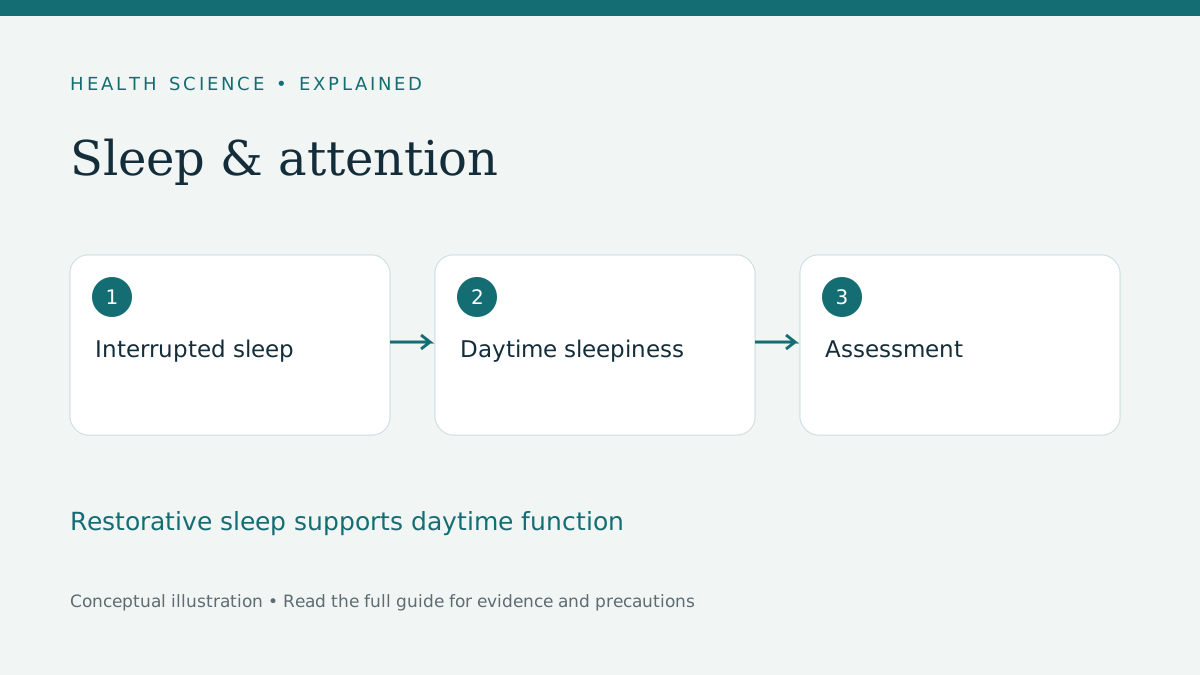
The missed connection between sleep and attention
Someone may spend eight hours in bed and still struggle to stay alert at a meeting, follow a conversation or remember an instruction. Time in bed does not describe how continuous or restorative sleep has been. Obstructive sleep apnea is one possible explanation: the upper airway repeatedly narrows or closes during sleep, disrupting breathing and often provoking brief arousals. Many of these awakenings are not remembered the next morning.
Poor concentration alone cannot identify sleep apnea. Work stress, insufficient sleep, medication effects, depression and other medical conditions can produce a similar complaint. The useful question is whether attention problems occur alongside a pattern of disturbed nighttime breathing and unrefreshing sleep. This shifts the discussion from buying a general memory aid to investigating a potentially treatable contributor.
Clues worth bringing to an appointment
Loud habitual snoring, witnessed breathing pauses and episodes of gasping or choking are relevant clues. Morning headache, dry mouth, daytime sleepiness and repeated nighttime urination may also occur. A person sleeping alone may have no witness to report breathing interruptions. Conversely, snoring without other symptoms does not establish the diagnosis. Body size can influence risk, but it should not be used to exclude the condition.
Record a typical week rather than trying to reconstruct one bad night. Note bedtime, approximate sleep duration, awakenings, alcohol use, sedating medicines and episodes of unintended sleep. If a partner has noticed a problem, describe what they actually saw or heard. A smartwatch alert may be worth discussing, but a consumer sleep score is not equivalent to a diagnostic sleep study. Avoid using either a reassuring score or an alarming score as a final answer.
What testing is designed to establish
Assessment begins with symptoms, examination and medical history. A clinician may arrange a sleep study to measure breathing, oxygen levels and other signals. Depending on the circumstances, testing may take place at home or in a sleep laboratory. Different tests record different information; selection matters when there are additional cardiopulmonary problems or concern about other sleep disorders.
The distinction between obstructive and central sleep apnea matters because their mechanisms and treatment pathways differ. In central sleep apnea, interruptions relate to the regulation of breathing rather than simply an obstructed upper airway. Ask what type of apnea the test suggests, how severe the abnormalities are and whether the findings explain the symptoms. A test result is most useful when interpreted with the clinical history.
Treatment and realistic expectations
Positive airway pressure is a standard treatment for obstructive sleep apnea. It supports an open airway during sleep. Depending on individual findings, other approaches may include a properly fitted oral appliance, changes in sleep position, weight management or selected procedures. These are clinical choices rather than interchangeable consumer purchases. Never stop an established treatment because one good night seems to have resolved the problem.
Improvement in sleepiness or daily functioning may follow effective treatment, but recovery is not identical for everyone. Concentration can remain poor if sleep duration is still inadequate or another condition is contributing. Follow-up should examine actual use, comfort, mask leakage and residual symptoms. Discomfort is a reason to seek adjustments, not a personal failure. A treatment that looks correct on paper must also be usable night after night.
Protecting everyday functioning while awaiting care
Sleepiness creates an immediate practical risk. Do not drive or operate dangerous equipment when drowsy, and do not rely on caffeine or an open window to make unsafe driving safe. Review sedating medicines and alcohol use with the treating clinician; do not abruptly change prescribed medication on your own. A regular opportunity for adequate sleep remains useful, but sleep hygiene alone cannot reliably correct repeated airway obstruction.
For work or study, use written instructions and reduce avoidable multitasking while the cause is being evaluated. These are organisational supports, not treatments for apnea. Keep an example of the problem, such as repeatedly missing part of a conversation despite adequate time in bed, so the appointment focuses on function rather than a vague label of brain fog. Follow-up can use the same example to assess change.
Where supplements fit into the decision
A supplement marketed for memory cannot mechanically keep an obstructed airway open. Research on an isolated ingredient should not be interpreted as evidence that a multi-ingredient formula treats sleep apnea. If you already use supplements, include them in the medication list so interactions and sedating effects can be considered. The first priority is an accurate explanation for the symptoms.
A useful next step is to request assessment when persistent daytime problems coexist with snoring, witnessed pauses or gasping. The aim is not to attribute every memory lapse to sleep apnea. It is to avoid overlooking nighttime breathing as a contributor to daytime performance. Explore other nervous-system articles in the Brain, Focus & Stress collection for related educational context.
Continue reading
Migraine Aura: Recognising the Pattern Without Missing an Emergency · Peripheral Neuropathy: Why Tingling Feet Need a Cause, Not a Guess
About the author
Medicinas Editorial Team prepares educational articles that distinguish established clinical knowledge from emerging hypotheses.
Medical note
This article provides general information, not an individual diagnosis or treatment plan. Discuss persistent or changing symptoms with a qualified healthcare professional. Seek urgent care for the warning signs described above.