
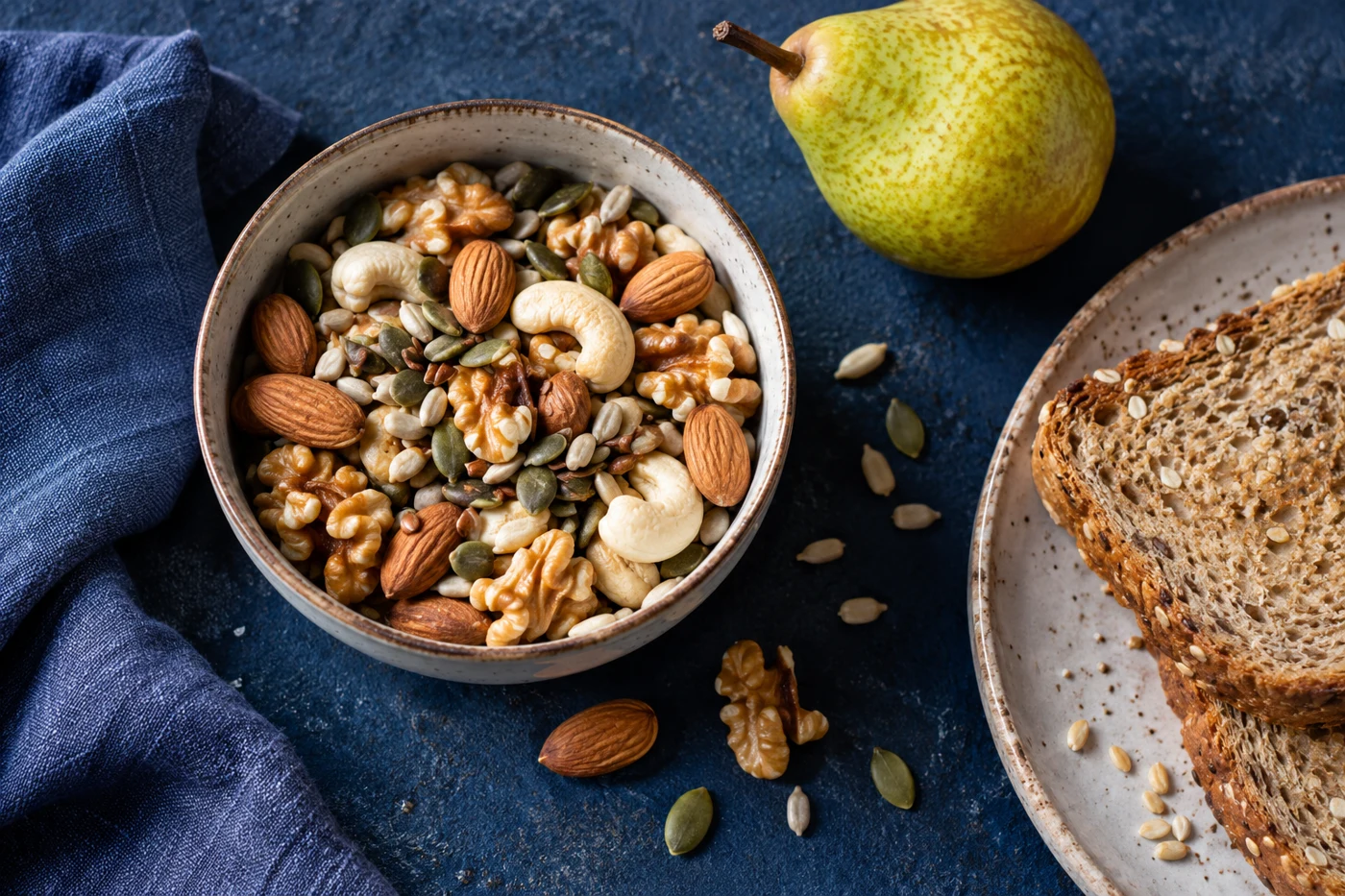
An old restriction can outlive its explanation
Some dietary rules survive because they are easy to remember, even after the evidence behind them has changed. The instruction to avoid nuts, seeds and popcorn after a finding of diverticula is one example. It offers a simple physical story: small particles might become trapped and cause trouble. The story feels intuitive, but an intuitive mechanism is not enough to establish that excluding those foods improves outcomes.
Before discussing the food rule, it is important to identify which condition is being discussed. A person whose diverticula were noticed incidentally during an investigation is not necessarily in the same situation as someone with an acute episode of diverticulitis. Advice for ordinary long-term eating should not be confused with instructions given during assessment or recovery from an active inflammatory illness.
Diverticulosis and diverticulitis are not interchangeable
Diverticulosis describes pouches in the wall of the colon. Diverticulitis refers to inflammation involving those pouches. The distinction is more than terminology: it changes what is being managed. NICE explains that uncomplicated diverticulosis itself does not require a specific treatment. Symptoms, active inflammation, bleeding and other complications require their own assessment rather than being inferred from the presence of pouches alone.
This helps prevent a common interpretive error. If a scan or colonoscopy mentions diverticula, it is tempting to attribute every later episode of abdominal discomfort to that finding. Yet a visible structural feature does not automatically explain a particular symptom. The useful question is whether the current presentation fits the suspected condition and whether another explanation needs attention. A prior finding should inform the consultation without dictating the answer.
Evidence: the nuts-and-seeds restriction did not hold up well
A prospective study by Strate and colleagues followed men in the Health Professionals Follow-up Study and examined nut, corn and popcorn consumption alongside diverticular outcomes. The reported findings did not support the assumption that those foods increased the risk of complicated diverticular disease. As an observational study, it cannot prove that a food prevents an outcome; its value includes directly questioning a widely repeated avoidance rule.
Current patient guidance from NIDDK and recommendations from NICE state that most people with diverticulosis do not need to avoid nuts, seeds or popcorn simply because of that diagnosis. This conclusion should not be stretched into a promise that any particular food will protect everyone. It means a blanket restriction needs a stronger justification than the idea that the food contains small particles.
A food pattern is more useful than a list of forbidden fragments
For long-term eating, NICE describes a balanced pattern including whole grains, fruit and vegetables. NIDDK discusses the potential relevance of fibre and overall dietary choices. These are pattern-level recommendations, not a demand that someone immediately tolerate a large bowl of bran. A diet can be changed gradually while considering existing constipation, bloating, preferences and other medical needs.
Think about what a meal provides and what would replace it if it were excluded. Removing nuts may take away a convenient food without solving the problem that prompted the restriction. On the other hand, someone with a nut allergy, swallowing difficulty or another specific reason to avoid a food still needs advice appropriate to that situation. Challenging one blanket rule does not erase all individual circumstances.
Practical implications: increase fibre without turning it into a contest
If a clinician recommends more fibre, a gradual change is often easier to assess than an abrupt increase. Introduce foods that fit ordinary meals, observe tolerance and discuss the response if symptoms become troublesome. Adequate fluid and an overall eating pattern matter alongside fibre choice. A numerical target is useful only if it can be translated into a diet the person can maintain.
It can help to begin with one repeated meal, such as adding a suitable wholegrain option at breakfast or including a familiar vegetable more regularly. The aim is to establish a workable pattern rather than prove that the gut can withstand the largest possible fibre load. If constipation or pain persists, more fibre is not automatically the next answer. Assessment may need to revisit the explanation and the management plan.
During an acute episode, the care plan takes priority
Long-term dietary advice is not a substitute for assessment of suspected acute diverticulitis. Significant or worsening abdominal pain, fever, vomiting, bleeding or inability to maintain fluids require clinical advice, with urgent care when the person is severely unwell. Do not use the absence of a dietary trigger as reassurance that active disease cannot be present. The immediate question is the nature and severity of the illness.
The American Gastroenterological Association’s clinical update describes an individualised approach to management and follow-up after diverticulitis. That includes considering the need for further investigation in context. Instructions about eating during recovery should come from the treating team and should be reviewed as the situation improves. A temporary clinical plan should not silently become a permanent restriction that is continued for years without reassessment.
Do not confuse food tolerance with proof of harm
Someone may notice discomfort after a particular meal and reasonably wish to avoid repeating the experience. The observation is worth discussing, but it is different from evidence that a seed has injured a diverticulum. Meal size, fat content, fibre amount, eating speed and other components can change together. Eliminating one item may appear to explain a response that actually has several contributors.
A useful record describes the meal, the timing and the actual symptoms without prematurely naming the mechanism. This makes it easier to compare alternatives and keeps the conversation open. Repeatedly expanding a forbidden-food list can make nutrition and social eating harder while providing little additional certainty. A dietitian can help maintain variety when restriction has become extensive or when several conditions have to be accommodated.
Limits and unanswered questions
Diet and diverticular disease research includes observational evidence and expert clinical guidance, with the usual limits of each. People who eat one food more frequently may differ in many other ways. A study that challenges avoidance does not answer every question about symptom control, recurrence or an individual’s preferred pattern. That is a reason to keep claims proportionate rather than return to an unsupported universal ban.
The more reliable practical principle is to separate the diagnosis, the immediate clinical situation and the long-term eating plan. Nuts and seeds are not the default enemy of a person with diverticula, but no single food is a universal solution either. Preserve a varied diet where possible, follow the acute care plan when needed, and ask for reassessment when symptoms or circumstances change. The goal is informed flexibility, not a new rigid rule.
Related reading
- Constipation and Fibre: Why Type and Pace Matter
- Psyllium Husk: How a Gel-Forming Fibre Changes Stool Consistency
- Resistant Starch: Why the Same Food Can Produce Different Gut Responses
- How IBS Is Diagnosed: Symptoms, Targeted Tests and Warning Signs
Author and medical note
Written by Gabriel Nicolaev – CyGuru. This article provides general educational information, not an individual diagnosis or treatment plan. Discuss persistent symptoms, medical conditions and medicine or supplement interactions with a qualified clinician. No independent medical review is claimed.