
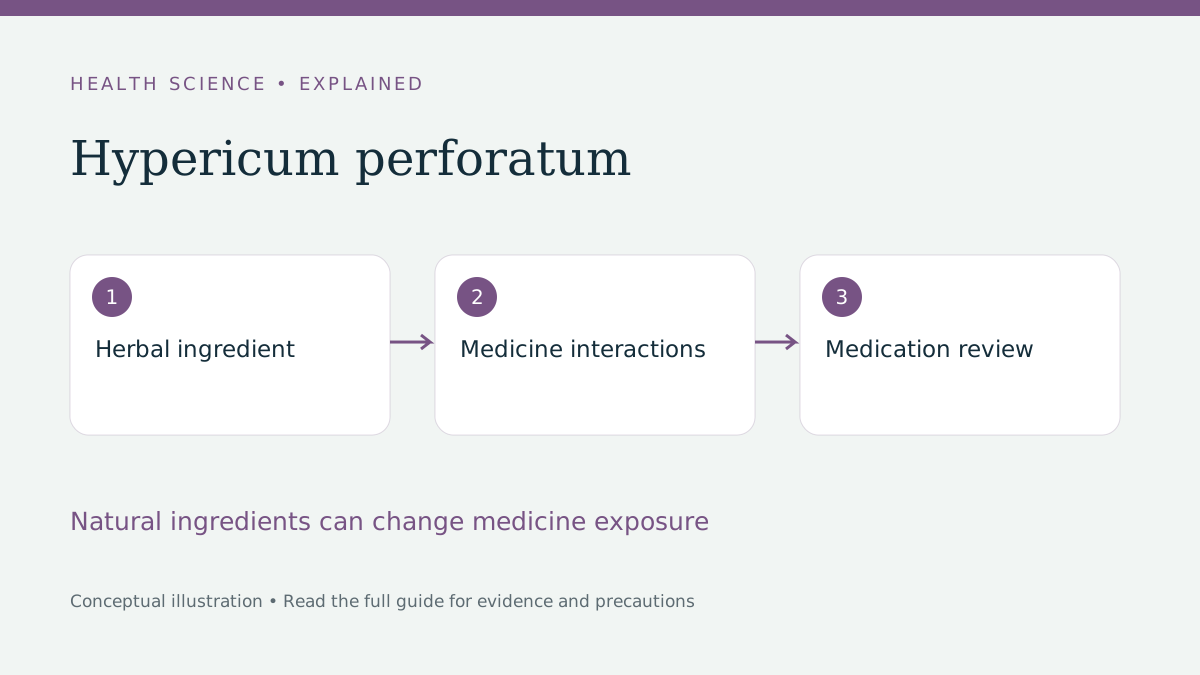
St John’s wort, Hypericum perforatum, illustrates why herbal safety cannot be judged by the word natural. A plant may contain compounds capable of producing biological effects and also alter the action of prescribed medicines. In this case, interactions are not a theoretical footnote. They are central to deciding whether a product should be used at all.
Many consumers look only for a warning about taking an antidepressant at the same time. That is too narrow. Hormonal contraception, transplant treatment, anticoagulation and other important therapies can also be affected. The right first step is a complete medication review, including the supplements already present in multi-ingredient products.
Two routes to an interaction
Some interactions occur because a substance changes how the body handles a medicine. St John’s wort can increase activity of drug-metabolising enzymes and transport processes, reducing exposure to certain medicines. The practical result can be a medicine becoming less effective even though the person takes every dose correctly.
Other interactions concern combined biological effects. Combining St John’s wort with medicines that increase serotonin can raise the risk of serious serotonin-related adverse effects. These two mechanisms explain why a simple instruction to take the herb at a different time of day is not an adequate solution. Separating breakfast and evening doses does not necessarily prevent a change in drug metabolism or overlapping effects.
The NCCIH overview warns that interactions can weaken life-saving medicines or cause dangerous adverse effects. This is not a reason to stop prescribed treatment. It is a reason to disclose the herb before making any change.
Contraception deserves an explicit conversation
The UK medicines regulator has warned about interactions between St John’s wort and hormonal contraceptives, including implants. Reports included suspected contraceptive failures. Someone may assume an implanted product avoids interactions because it is not swallowed, but the route of delivery does not remove all metabolism-related problems.
CDC contraceptive guidance similarly notes concern that St John’s wort can reduce the effectiveness of some hormonal methods. The implications depend on the method and the individual situation; they should be discussed with a contraception professional. Do not infer that all methods are equally affected or choose an alternative based on a generic supplement label.
If there has already been combined use and pregnancy is not wanted, contact a pharmacist or sexual-health service promptly for advice tailored to the method, timing and recent sexual activity. This is a time-sensitive medicines question, not something to postpone until the next online order.
Starting and stopping both matter
The Australian Therapeutic Goods Administration explains that stopping St John’s wort can also change medicine exposure as its enzyme-inducing effect wears off. Consequently, abruptly removing the herb from a long-standing combination is not always a self-contained fix. A clinician may need to monitor or adjust the affected medicine.
This is especially important when treatment has a narrow margin between too little and too much effect. Do not independently compensate by taking extra tablets or reducing a prescription dose. Bring the product packaging and explain when use began, how regularly it was taken and whether any recent changes occurred.
A useful medication list includes prescription medicines, over-the-counter products, vitamins, botanicals and occasional remedies. Record the exact brand and full ingredients, because a digestive or relaxation formula may contain St John’s wort without placing its name prominently on the front.
Mood symptoms require a broader assessment
Some research supports selected St John’s wort extracts for certain depressive symptoms, but that does not establish that any shop-bought product is an appropriate treatment. NCCIH advises against replacing conventional care or delaying assessment of a mental-health problem. Symptoms such as persistent low mood, loss of interest, altered sleep or impaired functioning deserve a conversation that considers their severity and context.
The decision is not simply between a herb and a prescription. Psychological treatment, social support, medical evaluation and medication may each have a place. A history of unusually elevated mood, markedly reduced need for sleep or impulsive behaviour is also important to tell a clinician before considering mood-related supplements.
If someone feels unable to remain safe, urgent local mental-health or emergency support takes priority over supplement selection. A product recommendation is not an appropriate response to an immediate safety crisis.
How to use this information when shopping
Treat the presence of Hypericum perforatum as a prompt to pause and check, even when it appears among many other plants. The journal's Megaliv ingredient guide demonstrates why the whole formula matters. A product's intended market category does not determine its interaction profile.
Ask a pharmacist a concrete question: does this exact formula interact with this complete medicine list, and what should happen if it has already been used? That question is more valuable than asking whether the product is generally safe. Good botanical advice is specific enough to recognise when a plant should be avoided, not merely persuasive enough to encourage another purchase.
Continue reading
Thyme for Cough: Why Tea, Extracts and Essential Oil Are Different · Psyllium Husk: How a Gel-Forming Fibre Changes Stool Consistency
About the author
Medicinas Editorial Team prepares educational articles by comparing clinical guidance and research with practical questions readers bring to everyday health decisions.
Medical note
This article provides general education, not a diagnosis or an individual treatment plan. Discuss persistent symptoms, medicines and supplement choices with an appropriately qualified clinician or pharmacist.