
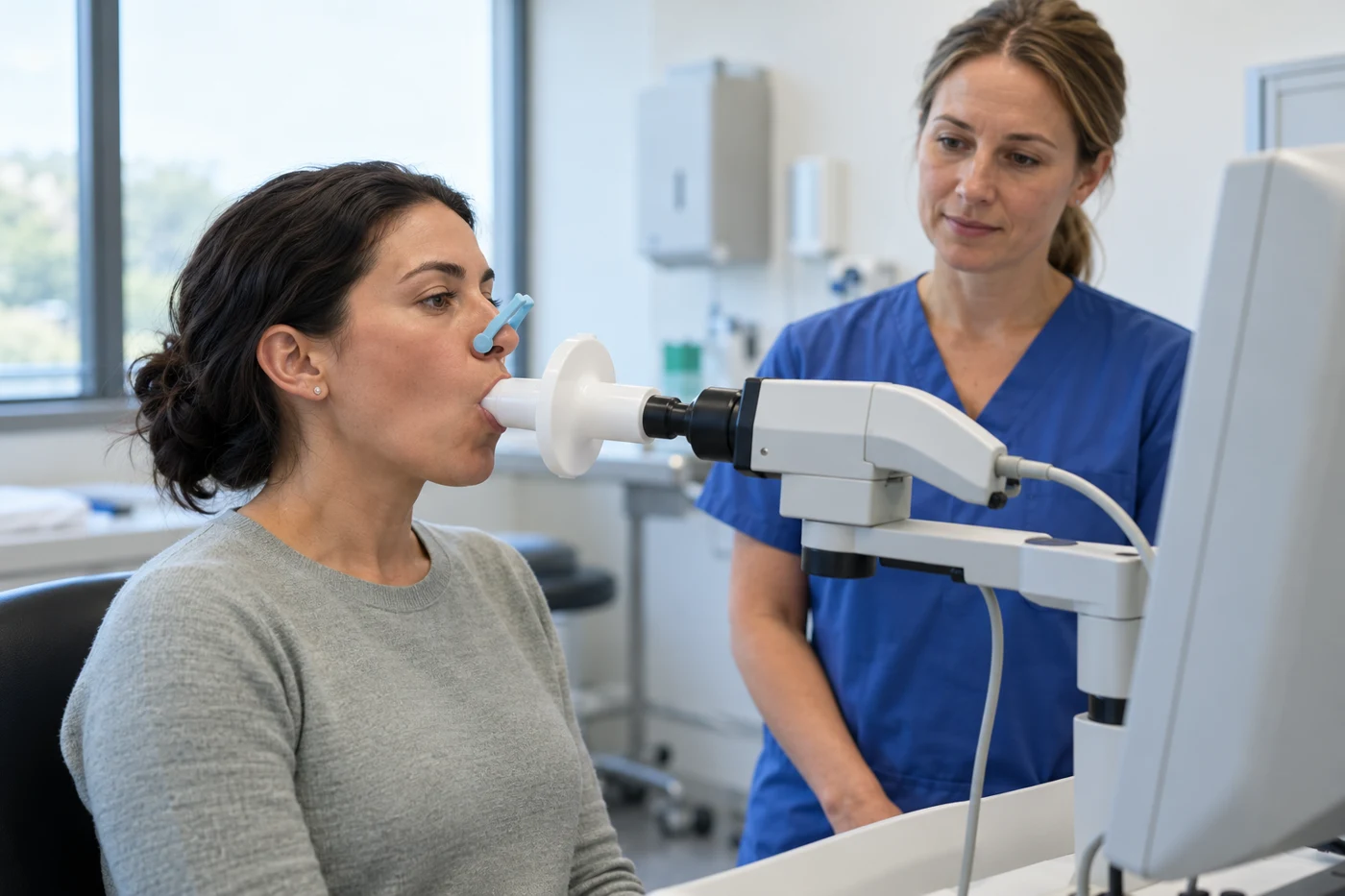
A number needs a question
A lung-function report can look more definitive than it is. Columns of measured values, percentages and coloured flags suggest a simple division between normal and abnormal. Yet the report is the result of a particular test performed on a particular day. Its usefulness depends on the question being asked, the quality of the manoeuvres and the clinical history around them.
Spirometry measures how air is expelled during a breathing manoeuvre. It can help evaluate symptoms and monitor an established respiratory condition. It does not produce a complete diagnosis independently of symptoms, examination and other investigations. Understanding that boundary makes the report more useful: it becomes evidence to interpret, rather than a label to adopt without explanation.
What FEV1 and FVC describe
FEV1 is the volume exhaled in the first second of a forced expiration. FVC is the total volume exhaled during the forced vital-capacity manoeuvre. Their ratio asks how much of that total leaves during the first second. Each measurement addresses a different part of the performance; none should be reduced to a generic score of lung health.
Two people can have a similar percentage-predicted FEV1 and still have different patterns, symptoms and treatment needs. The denominator matters when interpreting a ratio, and expected values depend on the reference framework used. A good explanation therefore identifies which values are being compared and why they matter for the individual question, rather than treating every low number as the same problem.
Evidence: technical quality comes first
The 2019 ATS/ERS standard describes how acceptable and repeatable spirometry should be obtained. A hesitant start, a cough that interferes with the manoeuvre, leakage or ending too early can affect what the equipment records. Repeating a manoeuvre is therefore not necessarily a sign that something is seriously wrong; it can be part of obtaining interpretable evidence.
The equipment is only one element of quality. Skilled instruction, the person's understanding and the assessment of the resulting curves all matter. A clinician may still obtain useful information when a test is imperfect, but confidence in the result must reflect its limitations. Ask whether the test met quality requirements before discussing what a flagged value means.
Obstruction describes a pattern of airflow
The ERS/ATS interpretive standard defines an obstructive ventilatory impairment through a low FEV1/FVC ratio relative to the lower limit of normal. Disease-specific guidance may use a fixed threshold in a particular diagnostic pathway. These approaches should not be mixed casually or presented as competing numbers that a patient must resolve alone.
An obstructive pattern can contribute to the assessment of conditions such as asthma or COPD, but it does not identify the cause by itself. Smoking and occupational exposure histories, symptom variation, previous treatment and additional objective findings may all influence interpretation. A result should lead to a coherent explanation of the evidence, including alternatives, rather than a diagnosis based on an isolated screenshot.
Why testing after a bronchodilator can matter
Some assessments repeat spirometry after a bronchodilator to examine a change in airflow. NICE recommends post-bronchodilator spirometry when confirming COPD in an appropriate clinical setting. The role of that measurement is specific: it is part of a diagnostic pathway, not proof that any person whose numbers improve has one particular disease.
Ask whether the report contains measurements before treatment, after treatment, or both. Also ask what instructions applied to regular inhalers before the appointment. Do not stop prescribed respiratory medicine on the basis of a general article. The test service should give preparation instructions suited to the purpose of the examination and explain what to do if those instructions are unclear.
A low FVC is not proof of restriction
A reduced FVC sometimes raises a question about restrictive physiology, but spirometry alone cannot confirm a reduction in total lung capacity. The ERS/ATS interpretive approach uses lung-volume measurements when confirmation is required. That distinction prevents a common error: taking a small exhaled volume as a complete description of how large the lungs are.
The American Thoracic Society explains that pulmonary-function testing can also include gas-transfer measurements and body plethysmography. These tests answer questions that spirometry cannot settle. An additional test is not necessarily evidence that the original one failed; it may be the correct next step because different measurements describe different aspects of respiratory function.
Practical implications: prepare for a useful conversation
Bring the reason for referral into the discussion. Was the test requested because of breathlessness, persistent cough, a relevant exposure or monitoring of an established condition? Ask how the observed pattern relates to that concern and whether the finding explains the full symptom burden. A numerical abnormality and a symptom can coexist without accounting for each other completely.
Useful questions include whether the manoeuvres were acceptable, which reference values were used, what the post-bronchodilator result added and whether another measurement would change management. If symptoms were absent on the test day, mention that too. The aim is not to challenge every number but to understand which decisions the result can reasonably support.
Preparation and repeat testing need context
The NHS advises that the test service will explain preparation and assess whether testing is safe in the setting of recent illness or relevant medical events. Report a chest infection, recent surgery or other new health information before the test rather than assuming the appointment must proceed unchanged. Disclose difficulties following the manoeuvre so staff can adapt the explanation.
For follow-up measurements, the circumstances of testing matter. A change in a number should be interpreted alongside technique, clinical events and the treatment context. Keeping reports together helps a clinician compare actual values and quality information instead of relying on memory that the last result was supposedly better. A trend is most informative when its conditions are understood.
Limits and unanswered questions
Reference ranges describe distributions, not a guarantee that every person on one side of a threshold is healthy and everyone on the other side has disease. Results near a boundary deserve proportionate interpretation, particularly when the clinical picture and measurement do not agree. Biological variation and measurement uncertainty are part of responsible interpretation, not exceptions to it.
Spirometry also cannot explain every cause of breathlessness or exclude every respiratory disorder. A reassuring result does not make persistent symptoms imaginary, and an abnormal one does not predict an individual's entire future. The appropriate endpoint is a clear plan for interpretation, further assessment when needed and review. A supplement cannot replace that process or turn an isolated result into a diagnosis.
Related reading
- Asthma Inhalers: Understanding Control, Relief and Your Action Plan
- A Cough After a Cold: Recovery, Reassessment and Warning Signs
- Sleep Apnea and Concentration: When Brain Fog Begins at Night
Author and medical note
Written by Gabriel Nicolaev – CyGuru. This article provides general educational information, not an individual diagnosis or treatment plan. Discuss persistent symptoms, medical conditions and medicine or supplement interactions with a qualified clinician. No independent medical review is claimed.